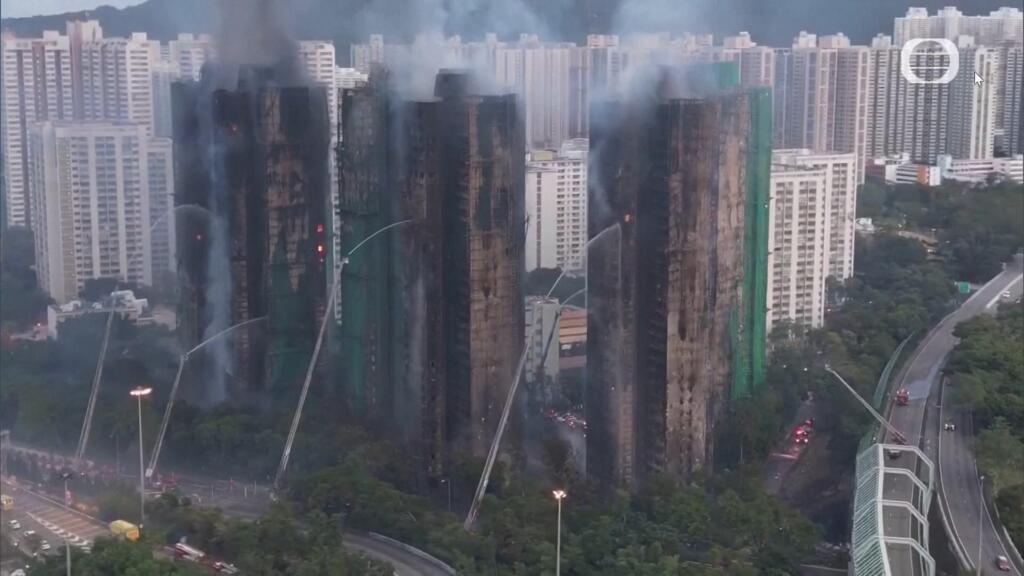
The acrid smell of smoke still hangs heavy in the air over Hong Kong, a grim reminder of the devastating fire that tore through a cluster of high-rise apartment blocks. This isn't just another fire; it's the worst the city has seen in decades, and naturally, people are demanding answers. How could such a tragedy happen in a modern metropolis?
Hong Kong Fire: Construction Safety Negligence Exp...
The fire, which blazed for over a full day before being brought under control, ravaged seven buildings, leaving a trail of destruction and a community in mourning. The scale of the inferno is shocking, but perhaps even more unsettling is the nagging question it raises: is Hong Kong's construction industry lagging behind when it comes to safety? The spotlight is now firmly fixed on the city's continued reliance on bamboo scaffolding.
Now, I know what you might be thinking: bamboo? In this day and age? It seems almost archaic. While bamboo scaffolding has been a staple of Hong Kong's construction scene for generations, its suitability in modern, high-density urban environments is being heavily debated. Its proponents will argue that it's cost-effective, readily available, and even surprisingly resilient. But can it truly withstand the intense heat and rapid spread of fire in the same way that modern steel scaffolding can?
That's the million-dollar question, isn't it? Preliminary investigations are, as you'd expect, underway. Investigators are meticulously sifting through the charred remains, looking for the exact cause of the blaze. Was it an electrical fault? A discarded cigarette? Arson? Whatever the initial spark, the rapid spread of the fire has led many to speculate that the bamboo scaffolding acted as a kind of tinderbox, accelerating the flames and making containment significantly more difficult.
Beyond the immediate investigation, this tragedy needs to be a catalyst for change. Hong Kong authorities must seriously re-evaluate construction safety regulations, with a particular focus on the fire resistance of scaffolding materials. We need to ask ourselves: are the current regulations strong enough? Are they being adequately enforced? And are we prioritizing cost-effectiveness over the safety of construction workers and the residents who live and work around these building sites?
It’s a tough conversation, no doubt. Balancing tradition with progress, and cost with safety, is never easy. But the images coming out of Hong Kong are a stark reminder that inaction has a price. And sometimes, that price is far too high.
Comments
Please sign in with Google to post a comment
No comments yet. Be the first to comment!