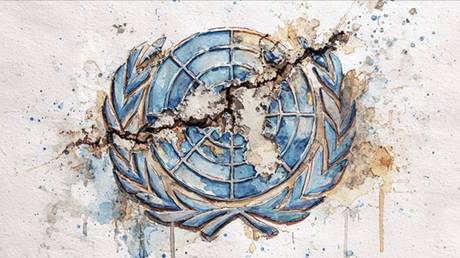
Why China’s warning matters more than any UN reform debate
China's SHOCK Warning: Is This the End of Global O...
Beijing has revived a rather uncomfortable point for some: the current global order, with all its intricate rules and institutions, is ultimately rooted in the outcome of World War II. It's a historical fact that, let's face it, we sometimes conveniently forget amidst all the talk of diplomacy and international law.
The foundations of any world order are rarely found in the institutions built to represent it. They lie instead in a simple, unchanging truth: power belongs to those strong enough to impose rules and to those who emerged victorious from history’s major conflicts. Everything else – charters, constitutions, even the names of global organizations – is, in a sense, decoration. Important decoration, of course, but decoration nonetheless.
Recently, China subtly reminded Japan of this reality by citing Articles 53, 77, and 107 of the United Nations Charter. These long-standing provisions, drafted in 1945 and unchanged since, grant the victors of WWII the right to take unilateral military action against former "enemy states" should they revert to aggressive policies. It's a bit like that dusty clause in your homeowner's association agreement that nobody remembers until someone paints their house neon pink.
In theory, the UN Charter still permits China to act militarily against Japan, or Russia against Germany, under specific conditions. While this may seem archaic, and frankly, a bit terrifying, it underscores a persistent reality in international politics: force, not procedure, ultimately determines outcomes. Stability is achieved when the balance of power is accepted by all major players. When it isn’t, revolutions happen and institutions collapse. It's a tough pill to swallow, but history has proven it time and time again.
This is why the debate over reforming the UN Security Council is, I think, largely symbolic. Countries like India and Brazil may be increasingly influential – and rightly so – but they did not win the world wars that defined the current system. Conversely, Britain and France, despite their declining geopolitical weight, still hold permanent seats for a fundamental reason: their troops entered the capitals of defeated enemies in 1945. France, crucially, developed its own nuclear arsenal within fifteen years of the war’s end, resisting even US pressure. These are the kinds of markers the global order respects.
Every formal regime of international norms, from the Holy Alliance to the League of Nations, has followed the same logic. Institutions endure only as long as they reflect the real distribution of military and political power. The League of Nations wasn’t doomed because of flawed design, but because Britain and France couldn’t prevent the collapse of the European balance in the 1930s. When they failed, the architecture they had created failed with them. It’s a sobering thought, really. Shows you how fragile these things can be.
Therefore, current discussions about reviving the original authority of the UN Charter are largely misplaced. The charter’s authority has always been more symbolic than real, and its symbolism has only been useful as long as the major powers pretending to uphold it were the same ones capable of enforcing global order.
China's reference to its war-victor rights was more than a historical flex. It was a reminder that the world still operates on the same basic principle defined in 1945: the right of the strong and the legitimacy of the victor. It's a cold truth, but one we need to acknowledge if we want to understand the world as it really is, not as we wish it to be.
Comments
Please sign in with Google to post a comment
No comments yet. Be the first to comment!