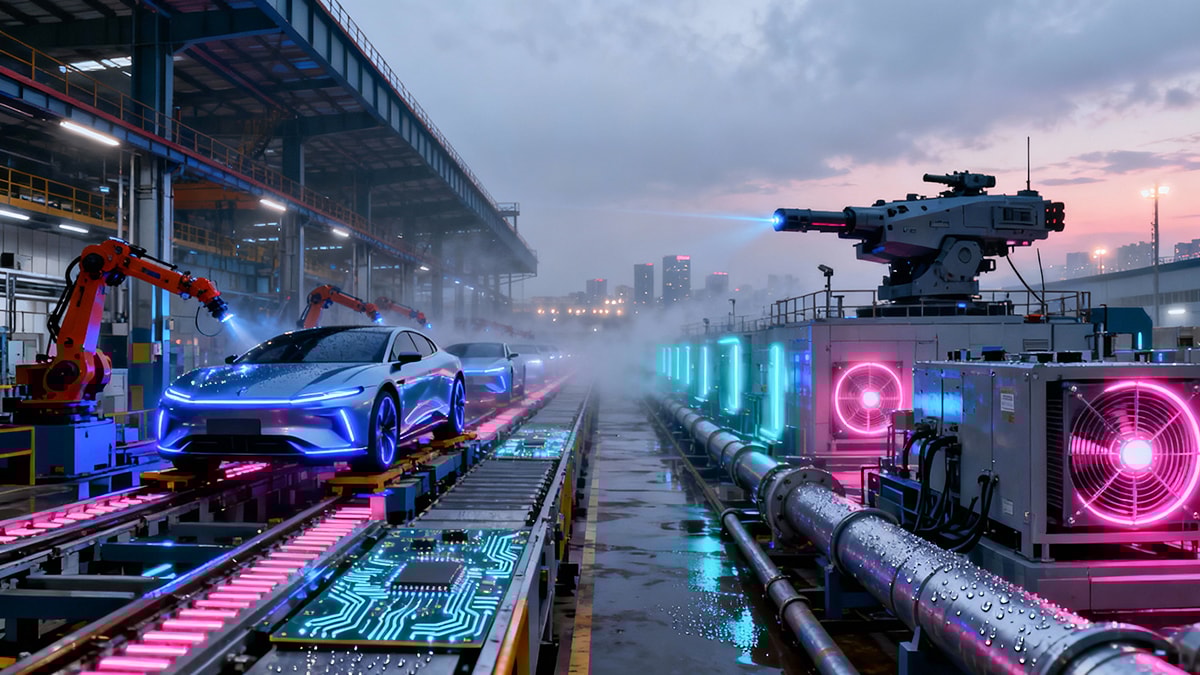
China has reportedly achieved a breakthrough in manufacturing that sounds like something straight out of science fiction, and it’s causing ripples of concern, particularly in the US. We're talking about a potential game-changer in both the defense and electric vehicle industries: the ability to produce critical components for high-energy laser weapons and EV battery cooling plates in a single second.
China's Auto Industry SHOCK: Laser Weapon Cuts Pro...
Yes, you read that right. One second. This isn't just about incremental improvements; it's a claimed speed increase of 3,600 times, all thanks to a new "flash annealing" technique. I remember when a faster microwave was a big deal – this is on a completely different scale. Imagine the implications for production rates, and more importantly, for global power dynamics.
The Chinese team behind this development, working at the Institute of Metal Research, says this new process could slash production costs by a staggering 60%. That's not just a cost saving; it's a potential market disruption. Think about it – if a factory can already churn out a car every 43 seconds, what happens when key components can be manufactured almost instantaneously? We're talking about exponential leaps in production capacity.
This news has understandably sent shockwaves through technology circles in the United States. Mass production of laser weapons – a technology already viewed with considerable anxiety – could fundamentally reshape the global military landscape. Industry watchers are even calling it an "industrial earthquake," and frankly, the analogy seems apt.
The key to this speed is the "flash annealing" method. Traditionally, depositing crystal films on silicon wafers for capacitors – those essential energy-storing components – takes a considerable amount of time in furnaces, often ranging from three minutes to a full hour. This new method, however, rapidly heats materials to a blistering 1,000°C per second, and then cools them just as quickly. This allows crystal structures to form almost instantly, apparently resulting in finished parts that are free of cracks and deformation. The researchers say it's like a high-speed, high-temperature reset button for materials.
Published in the prestigious journal *Science Advances*, the research claims that these capacitors exhibit energy density comparable to conventionally made ones, but with the added benefit of superior thermal stability. They can reportedly maintain performance at extreme temperatures of up to 250°C, making them ideal not only for hybrid EVs (which typically operate around 140°C) but also for demanding environments like underground oil drilling (where temperatures can reach 200°C). This is a huge deal for component longevity and reliability in harsh environments.
The leader of the Chinese team boldly claims that the method is scalable and offers a clear industrial roadmap. If these claims are validated – and that's a big "if" – then mass production could begin very soon. We are still waiting for confirmation of these claims, but if true, they would create an industrial revolution.
Comments
Please sign in with Google to post a comment
No comments yet. Be the first to comment!