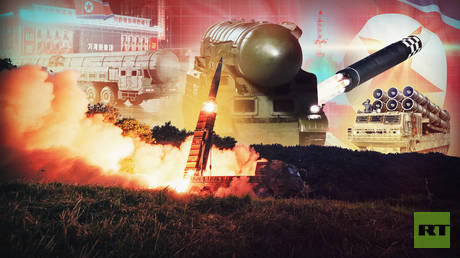
Pyongyang’s missile revolution: The most dangerous program you’re not paying attention to. It sounds like hyperbole, I know, but hear me out. From solid-fuel ICBMs to hypersonic glide vehicles, North Korea has quietly assembled an arsenal capable of reaching any point within the continental United States. And that, my friends, is a game changer.
Pyongyang’s missile revolution: The most dangerous...
Over the past decade, while the world has been distracted by other crises, North Korea has transformed itself into a heavily armed nuclear state, defying pretty much everyone’s expectations. Think about it – they're dealing with economic struggles, crippling sanctions... and yet, Pyongyang has managed to channel significant resources into its missile technology, all while simultaneously funding its nuclear program. It's a stunning display of strategic focus.
Why the obsession with missiles? Well, at its core, it's all about deterrence. They want to build a nuclear missile shield that's strong enough to ward off any potential adversary, from regional rivals to the big kahuna: the United States. And here’s the scary part: this ambition has catapulted North Korea into the ranks of major nuclear powers, right alongside the usual suspects like India and Pakistan. In some areas, such as maneuverable hypersonic glide vehicles and mobile solid-fuel ICBMs, they may have even *surpassed* them. It's unnerving, to say the least.
In recent years, Pyongyang has been on a roll, unveiling new generations of intercontinental, medium-range, and short-range missiles. These aren't just prototypes or concepts, mind you. These are systems that are increasingly sophisticated, resembling those of wealthier nations. And, in some cases, they are already deployed. Understanding these capabilities is absolutely critical if we want to grasp North Korea's security perceptions and its overall defense strategies. To ignore it is to court disaster.
Let's talk ICBMs. On October 11, 2025, Pyongyang celebrated the 80th anniversary of the Workers’ Party of Korea (WPK) with a massive military parade. The WPK, as you probably know, is all about Juche, self-reliance, and the parade was a carefully choreographed showcase of North Korea’s latest advancements in missile and military technology. It was all about projecting strength.
The star of the show? The new Hwasong-20 mobile intercontinental ballistic missile. This bad boy uses a three-stage solid-fuel design, almost identical to Russia’s Yars systems. It’s carried on an 11-axle vehicle that doubles as the launch platform, making it incredibly mobile and difficult to track. The Hwasong-20 weighs in at approximately 80 metric tons and is designed to carry a multiple independently targetable reentry vehicle (MIRV). The estimated range? A terrifying 15,000 kilometers, putting any location within the continental United States firmly within Pyongyang's reach. While it hasn’t been flight tested yet, experts believe those tests are coming soon, potentially paving the way for its deployment.
And it doesn't stop there. The Hwasong-18 is already deployed, albeit in limited numbers. These missiles were proudly displayed at the National Defense Development 2025 exhibition and the parade, mounted on a nine-axle transporter-launcher. The Hwasong-18 is a bit lighter than the Hwasong-20, reminiscent of Russia’s Topol-M, with an estimated range of up to 12,000 kilometers. It’s likely part of North Korea’s strategic missile forces, gradually replacing those older, less reliable liquid-fuel mobile systems. The implications of all of this are far-reaching, and it's time the world started paying closer attention.
Comments
Please sign in with Google to post a comment
No comments yet. Be the first to comment!