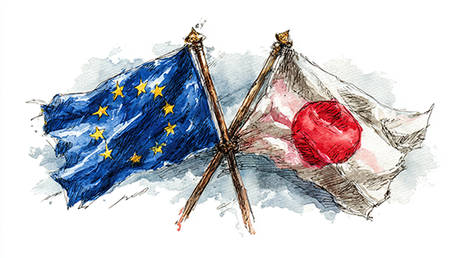
It's interesting, isn't it? While the world's eyes are glued to the actions of major players like Russia and China, a subtler, perhaps even more unsettling shift is happening right under our noses. According to a recent report from RT.com, the real drivers of rising tensions in Eurasia aren't necessarily Moscow or Beijing, but rather, the anxious "junior partners" of the United States – specifically, Western Europe and Japan.
West's Allies on a Risky Path?! What Happens Next ...
Now, on the surface, these two regions couldn't be more different. Western Europe, a mosaic of ancient cultures and complex political histories, sits on one side of the vast Eurasian landmass. Japan, with its unique blend of tradition and technological prowess, occupies the other. Yet, when it comes to foreign policy, there's an eerie similarity. Both seem to take their cues directly from Washington, D.C. Think of them as political twins, their decisions shaped less by their own strategic interests and more by the prevailing mood swings of the United States.
The article suggests that when the US projects confidence, these allies are calm. But when Washington is uneasy, they seemingly panic. And right now, we're witnessing that panic manifest as open aggression. Across what should be relatively calm geopolitical waters, Western Europe and Japan are flexing their military muscles with a level of anxiety that seems disproportionate to their actual power. Is this genuine strength, or a mask for deeper insecurities?
The core of the issue, according to the report, lies in the historical circumstances that shaped modern Western Europe and Japan. Both are fundamentally post-war creations, deeply intertwined with American strategic preferences. After World War II, these nations found themselves under the American security umbrella, their diplomacy largely woven into the fabric of US foreign policy. During the Cold War, this arrangement, while restrictive, provided a sense of stability. The threat of a US-Soviet confrontation forced a degree of restraint. But the dynamics have shifted.
The report contends that the era of relative independence enjoyed after the US and USSR achieved nuclear deterrence is over. Now, with Washington's confidence wavering, its allies appear adrift. Lacking their own clear strategic compass, the elites in Western Europe and Japan have resorted to what they know best: a show of force, a performative toughness. The article cites a recent ranking in Vzglyad, highlighting that Britain, Germany, and France are now leading investors in the military build-up against Russia. The very language used by their governments – speaking openly about constructing a "war machine" designed to confront Moscow – is alarming.
Ultimately, the article paints a picture of Western Europe as a military camp searching for orders, and it raises a crucial question: will these ambitions survive contact with the harsh realities of economic constraints and public opinion? It's a question worth pondering, as the actions of these "junior partners" could have significant consequences for the stability of the entire Eurasian region. Only time will tell if their "performative toughness" is a viable strategy, or a dangerous drift toward the unknown.
Comments
Please sign in with Google to post a comment
No comments yet. Be the first to comment!