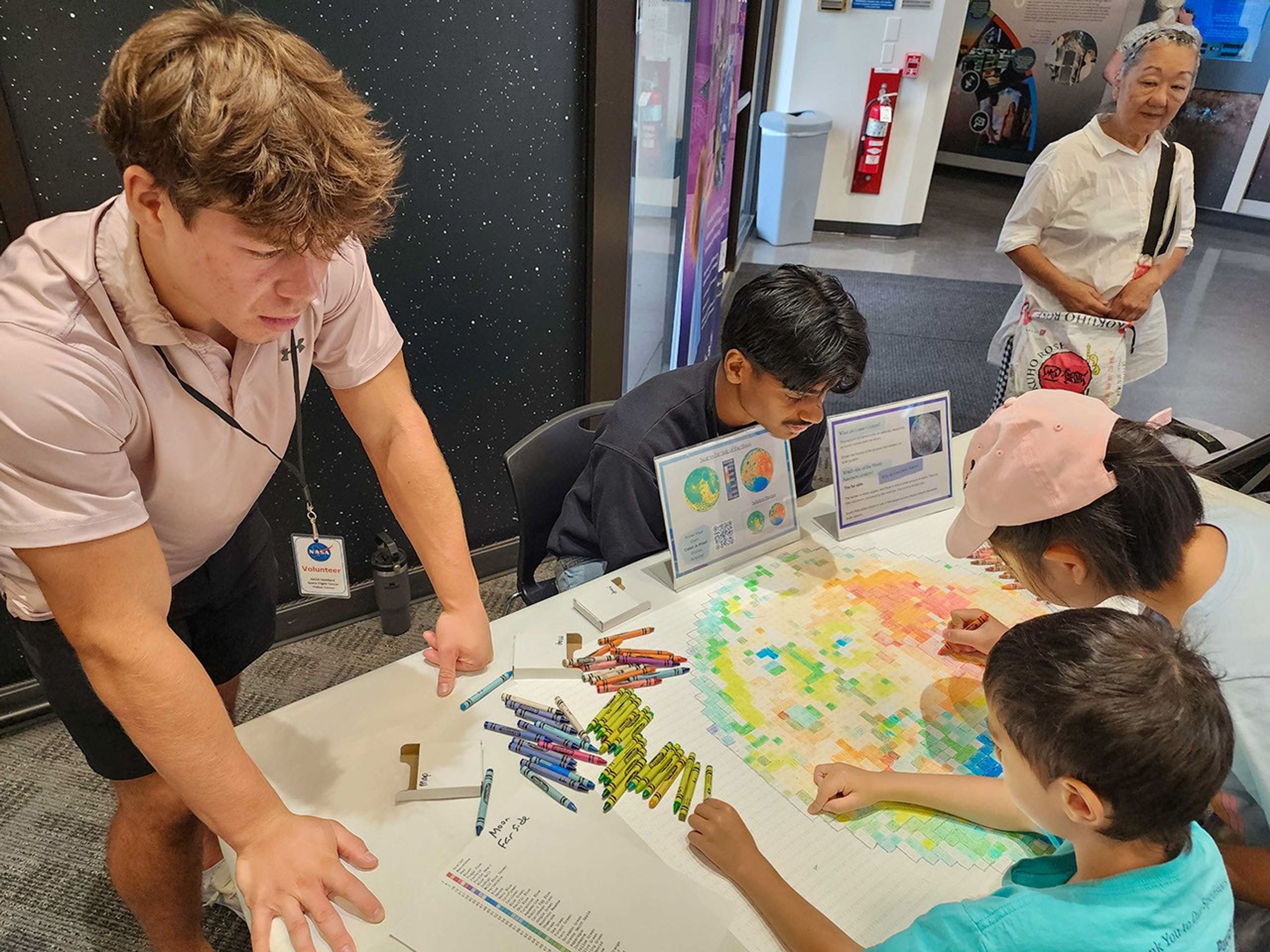
NASA has teamed up with the National Park Service and other groups in a rather ingenious initiative, one that uses the humble crayon to unlock the wonders of space and Earth science for millions of park visitors. It's called "Color-a-Pixel," and it's surprisingly effective.
NASA's Crayon Discovery: What Will It Reveal About...
The collaboration, orchestrated by the NASA Earth Science Education Collaborative (NESEC) and Earth to Sky (ETS), a growing partnership, is all about making complex satellite data accessible to everyone. Forget complicated charts and graphs; this project transforms those images into large, collaborative art projects. I have to admit, when I first heard about it, I was a little skeptical. Could crayons really explain the intricacies of NASA science? The answer, apparently, is a resounding yes.
The heart of the project lies in taking satellite imagery from missions like Landsat (which monitors Earth), the Mars Reconnaissance Orbiter (MRO), and the Lunar Reconnaissance Orbiter (LRO). These images, captured from space, are then processed into a 3x2 foot poster grid. Each square in the grid is assigned a number, which corresponds to a specific color from a set of 120 Crayola crayons. Simple enough, right?
Earth to Sky introduces the Color-a-Pixel activity to park rangers and educators during training workshops. According to Brandi Stewart, ETS Space Science Coordinator, the beauty is in its simplicity. "All you have to do is pick up a crayon, follow the easy number guides, and discover the stories that NASA satellites are telling us about our world and beyond." And it seems to work! People are immediately drawn in, eager to see the image emerge as they fill in the squares.
Geneviève de Messières, Earth to Sky Program Lead, emphasizes the teambuilding aspect. "It becomes a group mission that, by the end of the training, the image will be fully colored in and complete. It’s been a great teambuilding and stress-relieving activity for our participants," she said. I can see that. There’s something inherently satisfying about contributing to a larger picture, literally. It’s a bit like a giant, collaborative coloring book page come to life.
But it's more than just a fun activity. It's a powerful tool for education. When visitors work together to color in a satellite image, they’re also learning about the science behind it. They’re engaging with NASA's data in a tactile, memorable way, making that connection between Earth and the vastness of space. It’s a clever, low-tech solution to a high-tech problem: how to make complex scientific data engaging and accessible to everyone, one crayon at a time. It just goes to show, sometimes the simplest ideas are the most effective.
Comments
Please sign in with Google to post a comment
No comments yet. Be the first to comment!