**NASA Telescopes Offer Stunning New View of Spiral Galaxy NGC 1068**
Cosmic Whirlpool: NASA's Telescopes Capture a Gala...
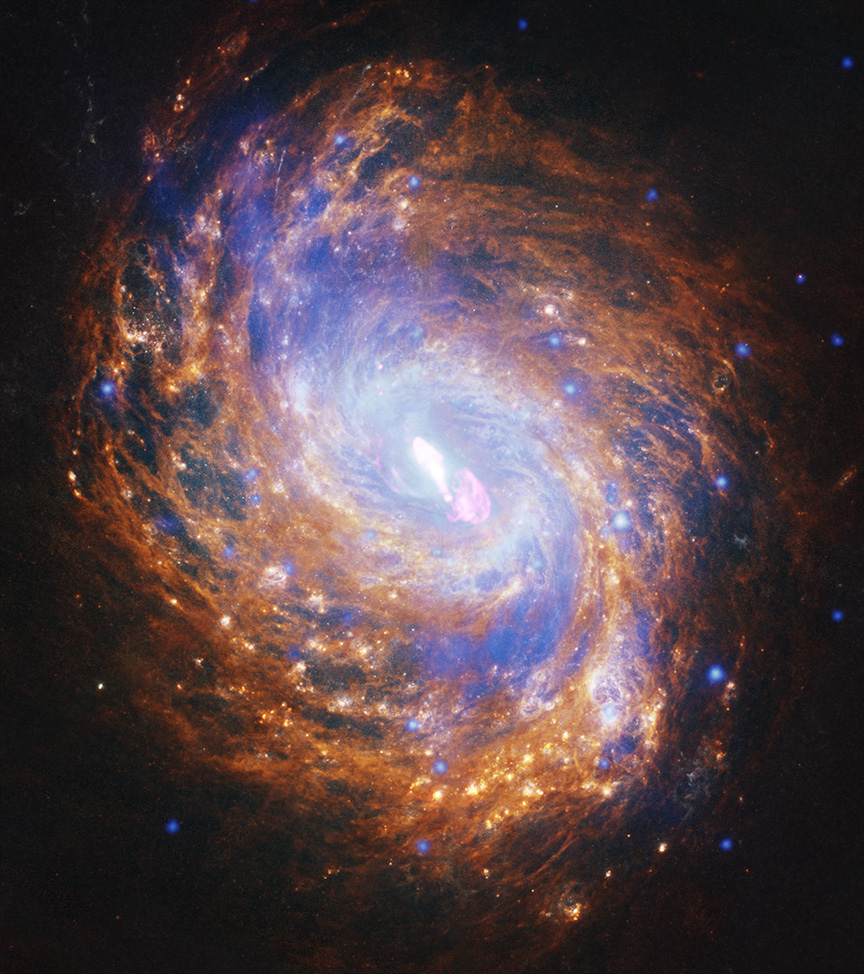
In a breathtaking display of cosmic collaboration, NASA has released a stunning new image of the spiral galaxy NGC 1068, revealing unprecedented details of its active galactic nucleus. The image, unveiled on July 23, 2025, combines data from several of the agency's most powerful telescopes, including the Chandra X-ray Observatory, the Hubble Space Telescope, and the James Webb Space Telescope, alongside radio data from the National Science Foundation’s Very Large Array.
NGC 1068, a relatively nearby galaxy,
NGC 1068, a relatively nearby galaxy, has long been a subject of intense study due to the presence of a supermassive black hole at its core. This black hole, a behemoth estimated to be twice the mass of the black hole at the center of our own Milky Way, is actively feeding, emitting powerful radiation and driving high-speed winds into the surrounding galaxy.
The Chandra X-ray Observatory data reveals the presence of a million-mile-per-hour wind emanating from the black hole. This wind, composed of superheated gas, is lighting up the central regions of the galaxy in X-rays, providing astronomers with valuable insights into the dynamics of active galactic nuclei. The X-ray data is represented in blue hues in the composite image, highlighting the energetic processes at play.
Complementing the X-ray data, radio observations from the Very Large Array (depicted in pink) trace the distribution of charged particles accelerated by the black hole's activity. These radio emissions provide a different perspective on the outflow of energy from the galactic center.
The Hubble and Webb Space Telescopes
The Hubble and Webb Space Telescopes contribute optical and infrared data (represented in yellow, grey, and gold) that showcase the galaxy's spiral arms, star formation regions, and dust lanes. The combination of these wavelengths allows astronomers to see through the obscuring dust and gas, revealing the underlying structure of NGC 1068 with remarkable clarity.
The collaborative effort highlights the power of multi-wavelength astronomy in unraveling the mysteries of the universe. By combining data from different telescopes that observe different parts of the electromagnetic spectrum, scientists can gain a more complete understanding of complex astronomical phenomena. The new image of NGC 1068 is a testament to this approach, providing a visually stunning and scientifically rich portrait of a dynamic and fascinating galaxy. The image processing was a collaborative effort by J. Schmidt and N. Wolk at the Chandra X-ray Center. This composite image is expected to fuel further research into the nature of supermassive black holes and their influence on the evolution of galaxies.
Comments
Please sign in with Google to post a comment
No comments yet. Be the first to comment!