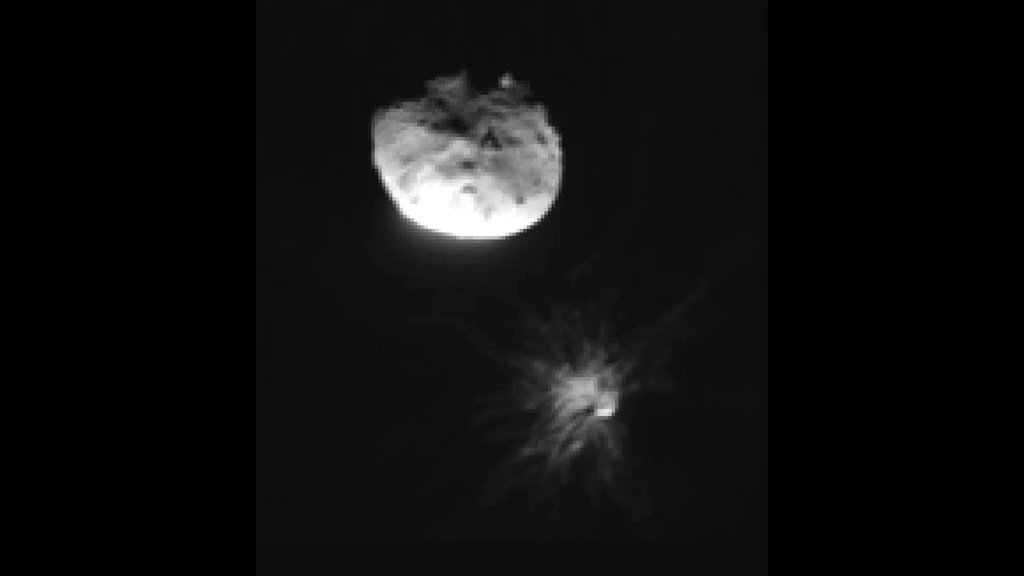
NASA's Double Asteroid Redirection Test (DART) mission wasn't just a cosmic bullseye; it was a planetary-scale nudge. We all remember the dramatic images from September 2022 when DART intentionally slammed into Dimorphos, the moonlet orbiting the larger asteroid Didymos. But new research reveals the impact had a ripple effect, subtly altering the pair's entire trajectory around the Sun.
Asteroid SHIFT! NASA's DART Mission Changes Space ...
The study, published in Science Advances, shows that the DART mission actually tweaked the 770-day orbital period of Didymos and Dimorphos around our star. Think of it like this: Didymos and Dimorphos are locked in a gravitational dance, orbiting a common center of mass. Changing the choreography for one inevitably affects the other. And this is the first time we've measurably altered the solar orbit of a celestial body. Pretty cool, huh?
"This is a tiny change to the orbit, but given enough time, even a tiny change can grow to a significant deflection," explains Thomas Statler, the lead scientist for solar system small bodies at NASA Headquarters. In essence, it's a testament to the power of a controlled collision. And, perhaps more importantly, it validates the "kinetic impact" strategy as a viable defense against potentially hazardous asteroids. It also demonstrates how impacting just one of a binary asteroid pair can change both asteroids' course. I have to admit, watching the live feed of the DART impact was nail-biting, even knowing the mission was a success. Seeing this further confirmation is just incredible.
The key to this orbital shift lies in the debris. The impact didn't just leave a dent; it blasted a cloud of rocky shrapnel into space, reshaping Dimorphos in the process. This ejected material acted like a rocket booster, adding extra momentum to the asteroid. Scientists call this the "momentum enhancement factor," and this new research suggests DART's impact had a factor of roughly two. So, the debris doubled the force compared to what the spacecraft alone would have exerted. The original data showed the impact shortened Dimorphos' orbit around Didymos by a significant 33 minutes. This latest research takes it a step further, showing it even changed the binary’s orbital period around the Sun by a minuscule, but measurable, 0.15 seconds.
"The change in the binary system’s orbital speed was about 11.7 microns per second, or 1.7 inches per hour," explains Rahil Makadia, lead author of the study from the University of Illinois Urbana-Champaign. "Over time, such a small change in an asteroid’s motion can make the difference between a hazardous object hitting or missing our planet." Okay, so it's not exactly warp speed, but the implications are significant. While Didymos itself poses no threat to Earth, this experiment highlights the potential of kinetic impactors to nudge potentially dangerous asteroids off course, provided we detect them far enough in advance. That's why NASA is developing the NEO Surveyor mission, a next-generation space telescope designed to find those elusive near-Earth objects that might otherwise sneak up on us. Planetary defense, it turns out, is a game of inches... or rather, 1.7 inches per hour.
Comments
Please sign in with Google to post a comment
No comments yet. Be the first to comment!