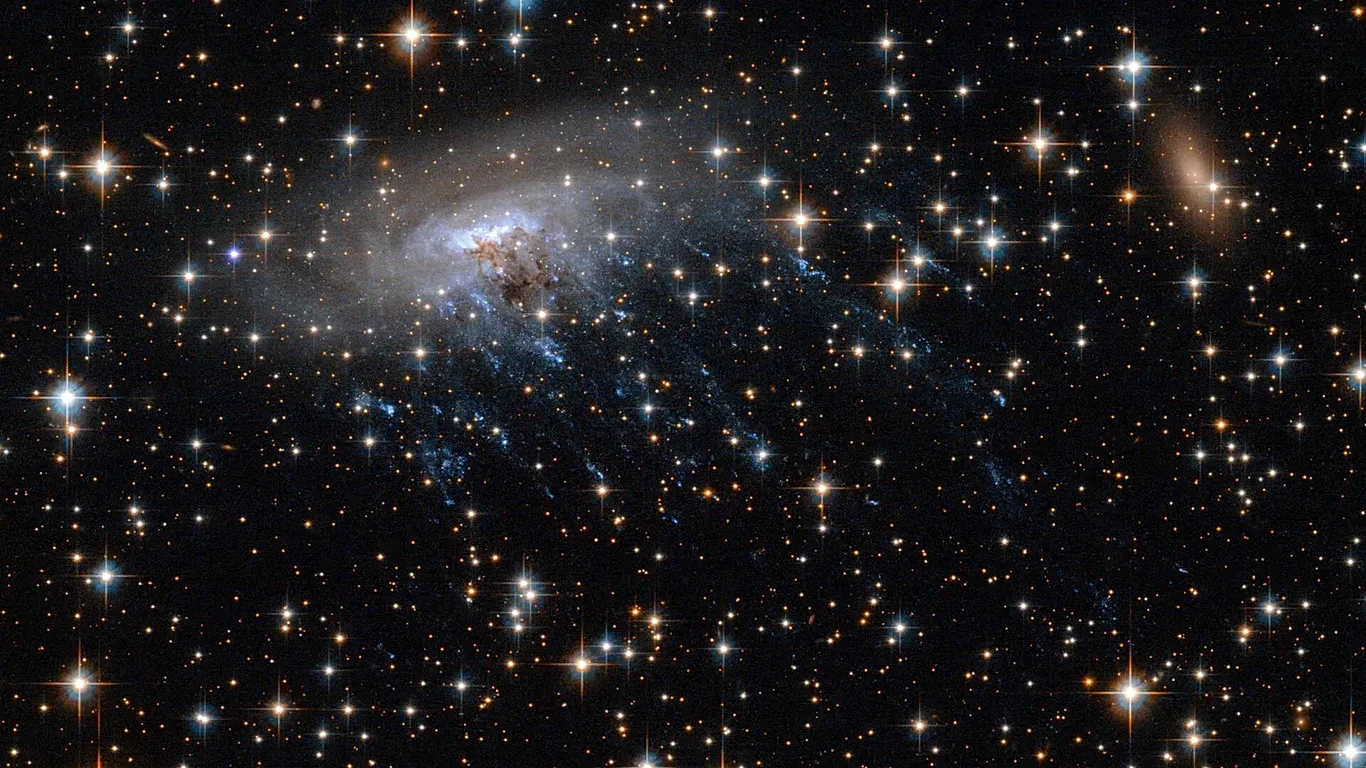
Astronomers have spotted a cosmic jellyfish, and it's the most distant one we've ever seen. Using the incredible power of NASA's James Webb Space Telescope (JWST), a team has identified a "Jellyfish galaxy" shining its light from a staggering 8.5 billion years ago. That's like looking back in time to when the universe was a relative youngster!
Jaw-Dropping Discovery! Is This Galaxy Shaped Like...
So, what exactly is a Jellyfish galaxy? Well, the name comes from its appearance. These galaxies sport long, trailing streams of gas that look eerily like the tentacles of a jellyfish. This peculiar formation isn't just for show; it's caused by something called "ram pressure stripping." Imagine a galaxy hurtling through a dense cluster of other galaxies, which are essentially swimming in a hot gas soup. As it speeds through this soup, the galaxy's gas gets stripped away, leaving those tell-tale trails.
This newly discovered jellyfish galaxy, sitting at a redshift of z = 1.156 (that redshift tells us how far away it is), shows this process in action. While the main body of the galaxy looks like a pretty typical spiral disk, it’s those bright blue clumps along the gas trails that really caught the researchers' eyes. These clumps are actually clusters of newly formed, incredibly young stars, born within the stripped gas far from the galaxy's main body. Pretty cool, right?
“We were looking for previously unstudied jellyfish galaxies by analyzing large data sets in this well-studied area of the sky,” explains Dr. Ian Roberts of the Waterloo Centre for Astrophysics, the scientist who initially spotted the galaxy. "While examining the JWST data, we quickly came across a distant and previously undocumented jellyfish galaxy." It’s amazing to think such a find was hiding in plain sight within the COSMOS field – one of the most thoroughly investigated patches of the sky! Goes to show you the power of new telescopes, I guess.
The discovery's implications are pretty significant. It suggests that galaxy clusters were already dense and potent environments capable of stripping gas from galaxies much earlier in the universe's history than previously thought. Before this, the prevailing wisdom was that these clusters hadn't yet built up enough density to exert such a strong influence. This new jellyfish finding is causing scientists to reconsider their models of early galaxy evolution. It also might provide insights into how "dead galaxies"—those that have stopped forming stars—emerge in these clusters.
The team, based at the University of Waterloo in Canada, has published their findings in *The Astrophysical Journal*. Now, they're eager to get more observation time with the JWST. Imagine what other secrets this cosmic jellyfish, and others like it, might reveal! The universe, even the bits we thought we knew, continues to surprise.
Comments
Please sign in with Google to post a comment
No comments yet. Be the first to comment!