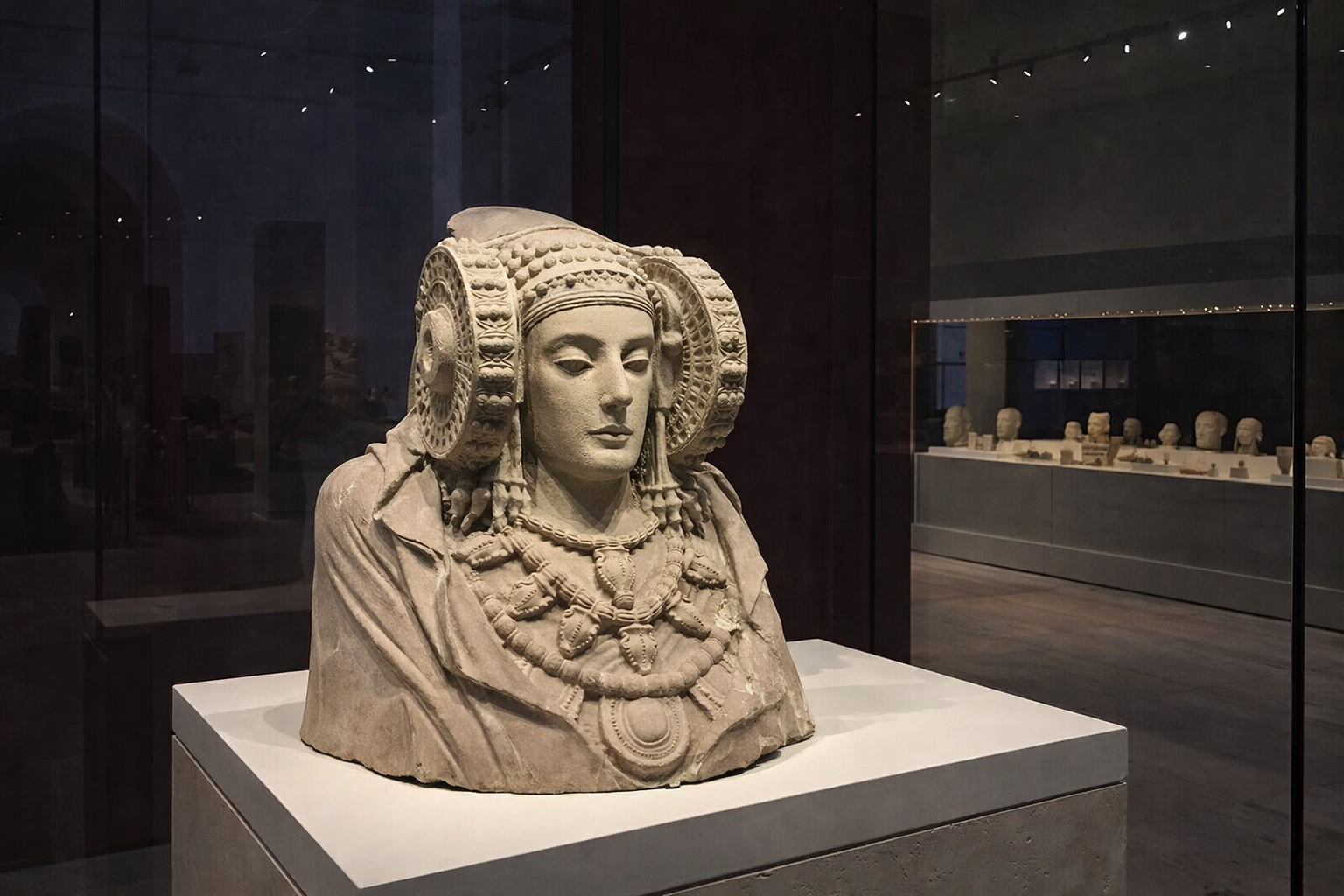
In the summer of 1897, a farmer in Elche, Spain, stumbled upon something remarkable: a stone bust now known as the Lady of Elche. This 2,400-year-old artifact depicts a mysterious female figure from the pre-Roman era, and frankly, its discovery sparked quite the controversy, and the enigma continues today.
2,400-Year-Old Statue: Fake?! The SHOCKING Secret ...
The bust itself is a beautiful blend of Iberian, Greek, and North African artistic styles, suggesting a period of intense cultural exchange. Crafted from a hefty limestone block, it stands at about 56 centimeters tall and weighs in at 65 kilograms. Imagine unearthing that! The Lady is adorned with a pointed crown and a diadem covered by a veil, giving her an air of authority. But it's the details that really catch the eye: the straps extending from the headdress, culminating in large rosettes, and the cape-like garment displaying three necklaces and amulets. What's really fascinating is that traces of paint suggest this wasn't just bare stone; she was originally painted, adding another layer of complexity.
Now, here's where it gets interesting. The unique appearance of the Lady of Elche initially led some to question its authenticity. Art historian John F. Moffitt even suggested in 1995 that it might be a 19th-century forgery, possibly created by the infamous Francisco Pallas y Puig. Can you imagine the uproar if that were true? However, scientific analyses have since come to the rescue. These tests confirmed the age of the paint and revealed that the ashes found in a large hole in the back of the bust (suggesting it was used as a funerary urn) were indeed from an ancient cremation. So, it seems the Lady is the real deal.
But the mystery doesn't end there. The identity of the Lady remains an enigma. Was she a goddess? A priestess? Experts are still divided. Some believe she represents Tanit, the chief goddess of ancient Carthage, hinting at religious connections between the Iberian and Phoenician peoples. The National Archaeological Museum of Spain, where she currently resides, still classifies her identity as mysterious. It’s almost as if she’s deliberately withholding her secrets! One interesting interpretation considers her "ultimately a noble Iberian woman, deified by her descendants." It's a compelling thought, blending human and divine attributes.
The Lady of Elche has had quite the journey. Discovered by chance among piles of stones, she was once moved to the Louvre Museum in Paris and later returned to Spain during World War II. She bears the marks of different cultures and eras, which really underlines her importance in both art history and archaeology. This unique artifact is an invaluable resource for understanding the social and religious structures of the Iberian Peninsula before the Romans. It's a testament to the power of art and history to continue to intrigue and challenge us, even after thousands of years. And the Lady of Elche, with her enduring mystery and striking beauty, will surely continue to captivate historians and researchers for generations to come.
Comments
Please sign in with Google to post a comment
No comments yet. Be the first to comment!