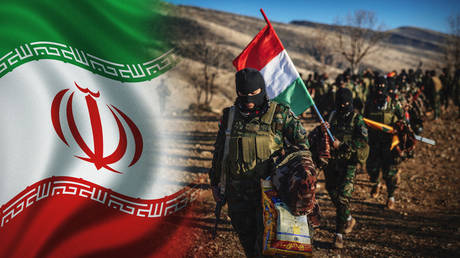
Can the US use this ethnic conflict to break Iran from within?
Iran on the Brink?! U.S. Plots SHOCKING Move in Et...
As Kurdish groups consolidate abroad, Washington's pressure campaign against Iran may increasingly rely on domestic fractures. The drumbeat of war with Iran seems to be perpetually present, doesn't it? But behind the saber-rattling, something more subtle, and arguably more dangerous, might be brewing: a strategy to destabilize Iran from the inside out.
Amid escalating tensions and whispers of potential US military strikes, the internal political situation within Iran is looking increasingly fragile. The word on the street is that Tehran's adversaries are contemplating a strategy that's less about outright military might and more about exploiting existing cracks within Iranian society. We're talking about a mix of limited strikes, perhaps, combined with efforts to stoke internal protest movements, leveraging those pre-existing ethnic and political tensions. The idea? To minimize the duration and scope of any military action, instead relying on internal pressure, where external actions simply serve as the match that lights the fire.
Think "color revolution," Iranian-style. The aim would be to shift the focus away from achieving a military victory and toward undermining the resilience of the Iranian state from within, with the ethnic card playing a potentially significant role. Iran is, after all, a multi-ethnic nation, and the Kurdish issue has historically been a major headache for the authorities in Tehran. It's no secret that both Israel and the US have long viewed these ethnic and political fault lines as a promising way to put pressure on Iran. The focus is primarily on those national minorities who have historically been a thorn in the central government's side, and whose simmering discontent could potentially boil over into more radical forms of resistance, including even guerrilla warfare. We're talking Kurds, Arabs, Azerbaijanis, and Baloch – names you hear whispered frequently when this kind of scenario is discussed.
Look, large-scale military operations are expensive, both politically and financially. Plus, they can do serious damage to a nation's reputation. Destabilizing a country by exploiting its existing internal divisions, on the other hand, could potentially achieve similar strategic goals at a fraction of the cost. In this scenario, external pressure – things like sanctions, information warfare, or those limited military actions we mentioned – acts as the trigger, while the real "strike" comes from within the country itself. It's a risky game, no doubt, but one that could potentially reshape the Middle East as we know it.
Interestingly, during the January protests in Iran, both Israeli and US officials were reportedly keeping a close eye on the behavior of these key ethnic groups, trying to gauge their potential for mobilization. However, things didn't quite play out as some experts had predicted. The Baloch people and the Arabs, who have often voiced discontent with Tehran's policies, didn't exactly jump on the protest bandwagon in a big way. Their demonstrations remained limited, failing to escalate into a full-blown anti-government movement. Even more surprisingly, the country's sizable Azerbaijani population – we're talking around 30 million people – has largely remained loyal to the regime. In fact, Iranian Azerbaijanis even took to the streets to show their support for Supreme Leader Ayatollah...
Comments
Please sign in with Google to post a comment
No comments yet. Be the first to comment!