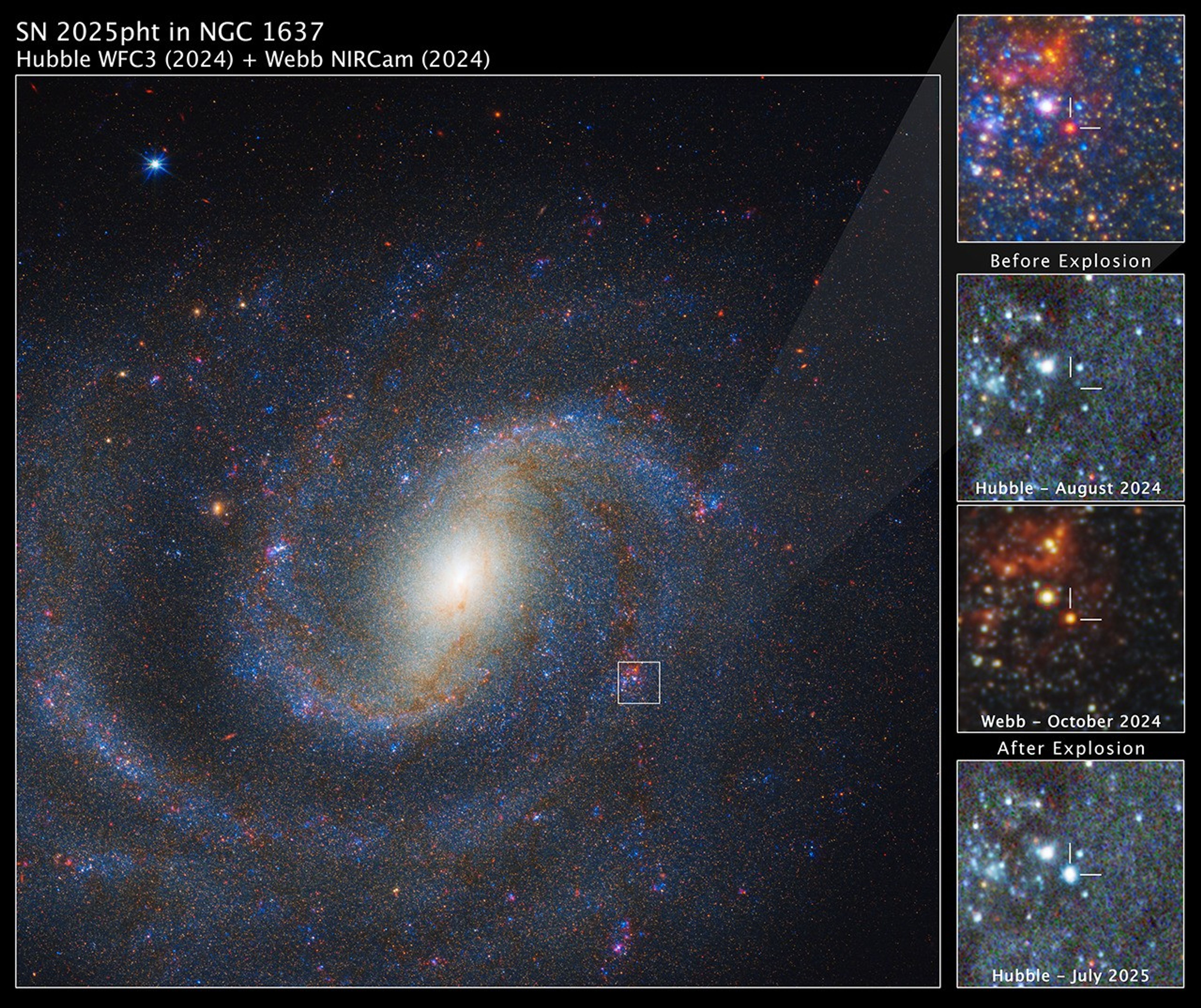
Forty million years ago, a star in a galaxy far, far away (well, not *that* far, cosmically speaking) decided to go out with a bang. That explosion, a Supernova, sent light rippling across space, a light that finally reached our little corner of the universe on June 29, 2025. And you know what happened next? Astronomers went wild, naturally!
Webb Telescope Uncovers Ghost Star! What Secrets W...
The All-Sky Automated Survey for Supernovae (ASAS-SN), a fittingly dramatic name, was the first to spot the cosmic fireworks, promptly labeling it Supernova 2025pht. Now, most astronomers would focus on analyzing the supernova itself, dissecting its light spectrum and trying to understand the physics of the explosion. But one team had a slightly different, arguably more intriguing, idea.
They wanted to find the star that *caused* the supernova. Think of it as cosmic CSI: Who was the victim? What were they doing before they met their explosive end? Luckily, they had a powerful tool at their disposal: NASA's James Webb Space Telescope (JWST). And guess what? They found it! Images captured by JWST of galaxy NGC 1637 revealed a red supergiant precisely where the supernova now resides. This marks the first published instance of Webb catching a star red-handed (or should I say, red-spectrally-handed) before it went supernova. The findings were published in *The Astrophysical Journal Letters*.
"We've been waiting for this moment – for a supernova to erupt in a galaxy already observed by Webb," said lead author Charlie Kilpatrick of Northwestern University. That's understandable, right? It's like having the perfect 'before' picture right before disaster strikes. "By combining Hubble and Webb data, we've been able to completely characterize this star for the first time," Kilpatrick added.
But here's where the story gets really interesting. This red supergiant was *super* red, even for a red supergiant. By carefully comparing Hubble and Webb images, the team determined that the star was shrouded in a massive amount of dust. I mean, *massive*. "It's the reddest, most dust-laden red supergiant we've ever seen explode as a supernova," said Aswin Suresh, a graduate student and co-author. Now, why is this dusty situation so important?
Well, it might solve a cosmic mystery: the missing red supergiants. See, astronomers expect that the most massive stars that eventually go supernova should be bright and easy to spot in pre-supernova images. But that hasn't always been the case. Where are they all hiding? One theory is that the most massive, aging stars are also the dustiest, essentially cloaking themselves in cosmic grime. And the Webb observations of supernova 2025pht seem to support this idea. "I've long advocated for this interpretation, but even I was surprised by the extreme nature of supernova 2025pht," said Kilpatrick. "It could explain why these more massive supergiants are missing, as they tend to be more dusty." So, problem potentially solved! Sometimes, the answer is just… dust. Who knew?
Comments
Please sign in with Google to post a comment
No comments yet. Be the first to comment!