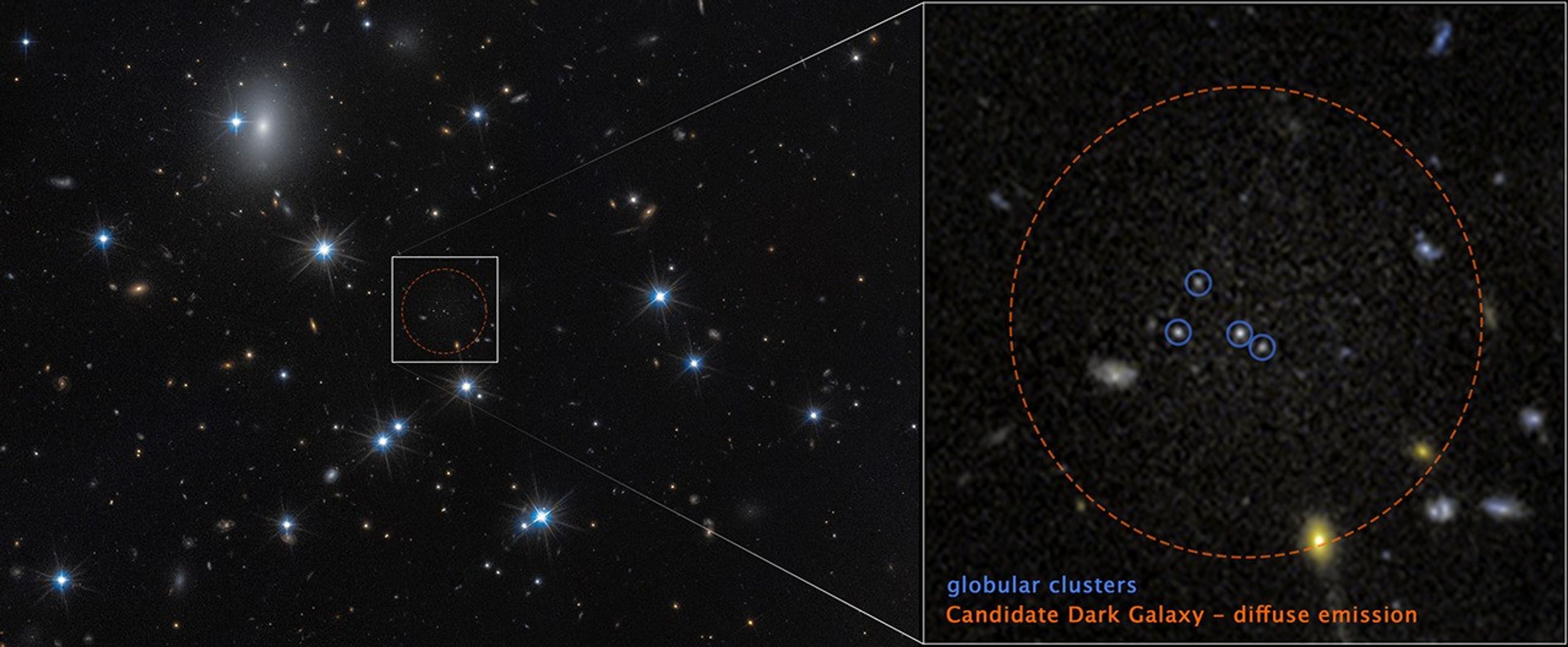
In the inky blackness of space, where galaxies usually blaze with the light of billions of stars, a ghost lurks. NASA's Hubble Space Telescope, along with some earthly companions, has helped astronomers identify one of the darkest galaxies known to exist, aptly named CDG-2. Forget shimmering spiral arms or vibrant nebulae; this galaxy is so dominated by Dark matter, it barely registers a flicker of light.
Hubble Uncovers Galaxy So Dark, It Defies Everythi...
Now, Dark matter, for those who aren't astrophysicists (and let's be honest, that's most of us), is the mysterious stuff that makes up a huge chunk of the universe but doesn't interact with light. We can't see it, but we know it's there because of its gravitational effects on things we *can* see. In CDG-2's case, the dark matter is practically running the show.
The discovery, published in *The Astrophysical Journal Letters*, highlights just how clever astronomers have to be these days. Finding these low-surface-brightness galaxies isn't easy. David Li, from the University of Toronto, and his team used a clever trick: they looked for groupings of globular clusters. These are dense, spherical collections of stars that often orbit larger galaxies. Think of them as tiny, sparkly breadcrumbs leading to the dark galaxy itself.
To confirm that CDG-2 was indeed a galaxy and not just a random collection of clusters, the team brought out the big guns: Hubble, the European Space Agency's Euclid telescope, and the Subaru Telescope in Hawaii. Hubble’s sharp eyes pinpointed a tight group of four globular clusters within the Perseus galaxy cluster, a cool 300 million light-years away. Further observations by all three telescopes revealed a faint, hazy glow surrounding these clusters, the telltale sign of the hidden galaxy. It's like finally finding the forest for the trees, only the forest is almost entirely invisible!
“This is the first galaxy detected solely through its globular cluster population,” explained Li. It turns out that these four clusters likely represent the *entire* globular cluster population of CDG-2. Initial estimates suggest that CDG-2 has about 6 million times the luminosity of our Sun, but a whopping 99% of its mass is dark matter! The remaining 1% is the visible stuff, and even then, a significant portion of *that* is tied up in the globular clusters. What little normal matter existed in the form of hydrogen gas to form stars has probably been stripped away over time by its interactions with other galaxies within the Perseus cluster.
This discovery showcases the power of combining different observational techniques and increasingly sophisticated data analysis methods like machine learning. As new telescopes like the upcoming Nancy Grace Roman Space Telescope and the Vera C. Rubin Observatory come online, the amount of data we'll be swimming in will be immense. The ability to sift through all that data and find these hidden gems will be crucial. And let's not forget Hubble; even after more than three decades of operation, it's still helping us unlock the universe's biggest secrets, one faint galaxy at a time. It makes you wonder what other dark and mysterious objects are lurking out there, waiting to be discovered.
Comments
Please sign in with Google to post a comment
No comments yet. Be the first to comment!