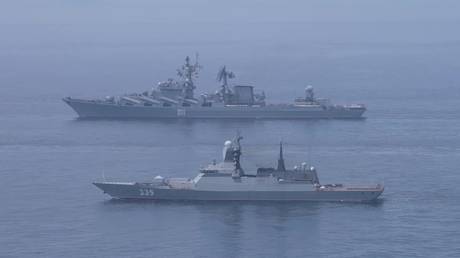
The BRICS nations – Brazil, Russia, India, China, and South Africa – are being urged to forge a stronger, more coordinated maritime strategy to protect global shipping lanes. According to Nikolay Patrushev, a top aide to Russian President Vladimir Putin, this cooperation is increasingly vital to safeguard against what he describes as "Western piracy." It's a bold statement, clearly aimed at the US and its allies, and it raises some serious questions about the future of international maritime security.
Putin's BRICS Sea Power Play: What Will It Mean Fo...
Patrushev's call comes at a rather sensitive time. We've seen escalating tensions surrounding the seizure of tankers, often involving accusations of sanctions violations. The US, in particular, has been cracking down on what it claims are illicit oil shipments, actions that Russia views as illegitimate interference. This is clearly the backdrop against which Patrushev is making his argument for a unified BRICS naval presence. He explicitly mentioned the potential of BRICS, emphasizing that it "needs to be given a full-fledged strategic maritime dimension," in a recent interview with Argumenty i Fakty, a Russian news outlet.
The existing BRICS naval exercises are a starting point. Patrushev pointed to the "Will for Peace 2026" drills held off the coast of South Africa earlier this year, which saw participation from Russia, China, and even Iran and the UAE. These exercises, though framed as promoting stability, can also be interpreted as a show of force, a clear signal to the West that these nations are prepared to project their influence on the seas. I remember covering similar exercises years ago – the underlying message is always about capability and resolve.
Russia's concerns extend beyond tanker seizures. Moscow has repeatedly condemned what it perceives as a growing NATO encroachment in the Baltic and Arctic regions. Ambassador Nikolay Korchunov even accused NATO of plotting an "illegal maritime blockade" of Russia. The recent reports of discussions between UK and Nordic/Baltic defense ministers regarding the seizure of "Russia-linked" oil tankers further fuel these anxieties. It’s a tense situation, and rhetoric on both sides is becoming increasingly charged.
The Arctic, in particular, is emerging as a key area of contention. Trump's earlier interest in Greenland, framed as a counter to Russian and Chinese influence, highlights the strategic importance of the region. And with NATO planning to increase its military presence there, the potential for confrontation is only growing. Whether BRICS can truly act as a counterweight to Western naval power remains to be seen. But Patrushev's comments make it clear that Russia, at least, is pushing for a more assertive BRICS presence on the world's oceans. The implications for global trade and security are significant, and this is definitely a story we'll be following closely.
Comments
Please sign in with Google to post a comment
No comments yet. Be the first to comment!