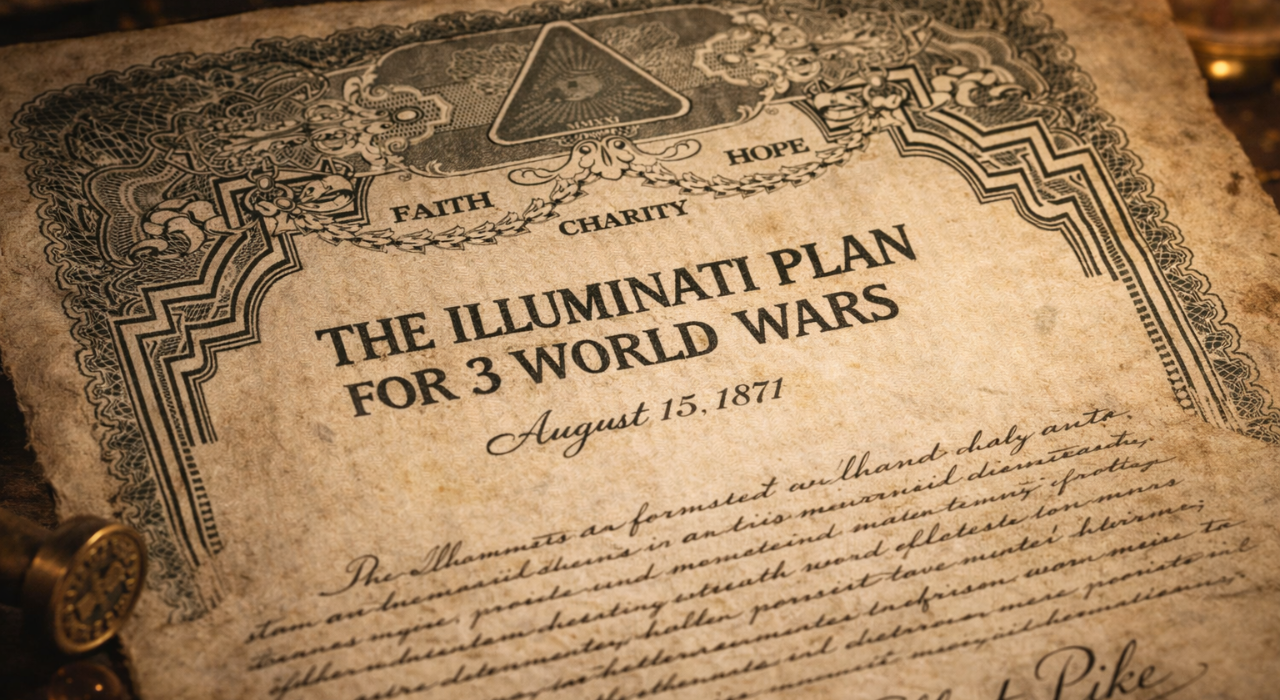
The internet loves a good conspiracy theory, and few have as much staying power as the alleged "Pike letter." This supposed document, penned in 1871, purports to foresee three world wars: the first to dismantle empires and usher in communism, the second to defeat fascism and pave the way for the establishment of Israel, and a third, future conflict between Western and Islamic powers, leading to global upheaval and a radical transformation of religion. It's a captivating narrative, to be sure, but is there any truth to it?
Freemason's Chilling WWIII Prophecy: Islam vs. Zio...
The claim is that Albert Pike, a Confederate general turned Masonic philosopher, wrote to the Italian revolutionary Giuseppe Mazzini, forecasting these three global conflicts. According to the letter, the first culminated in World War I, and the second unfolded as World War II. Both wars dismantled empires and reshaped global political ideologies. The letter further predicts a third, still yet to come, a final global conflict that would transform religion and reorder the world. Sounds dramatic, right?
Here's the problem: no original manuscript has ever surfaced. Proponents of the letter often claim it was once displayed in the British Museum before mysteriously disappearing. However, both the British Museum and the British Library have stated unequivocally that they have no record of such a document. No manuscript has ever been produced, and no catalogue entry confirms its existence. Despite the lack of evidence, the text, or rather, versions of it, continues to circulate. I've seen it cited in books, sermons, and online forums as "proof" that the catastrophes of the 20th century weren't accidents of history, but steps in a longer, deliberate design.
So, who were these guys anyway? Giuseppe Mazzini (1805–1872) was a key figure in Italian unification, the Risorgimento. A journalist, exile, and political conspirator, he founded Young Italy (Giovine Italia), a secret society dedicated to creating a unified, republican Italy. He advocated for popular sovereignty, nationalism, and democratic revolution at a time when much of Europe remained under monarchic rule. He moved through networks of activists and clandestine groups, including the Carbonari, and like many 19th-century political reformers, he was associated with Freemasonry. Mazzini's actual writings and political activities were indeed quite revolutionary for his time.
Albert Pike (1809–1891), meanwhile, built his reputation in a very different arena. Born in Massachusetts, he traveled west, became a newspaper editor and lawyer in Arkansas, fought in the Mexican–American War, and later served as a brigadier general for the Confederacy during the American Civil War. After the war, he became a prominent figure in Freemasonry, developing his own interpretation of Masonic symbolism and philosophy. While he was undoubtedly an intellectual and a writer, there's no credible evidence linking him to this alleged letter.
The appeal of the Pike letter likely lies in its neat, almost too-perfect, explanation for the chaos of the 20th and 21st centuries. It offers a sense of control and understanding in a world that often feels incomprehensible. However, the lack of verifiable evidence means it should be approached with extreme skepticism. While the ideas and individuals involved are interesting historical subjects, the supposed Pike letter appears to be nothing more than an elaborate hoax that continues to thrive in the echo chambers of the internet.
Comments
Please sign in with Google to post a comment
No comments yet. Be the first to comment!