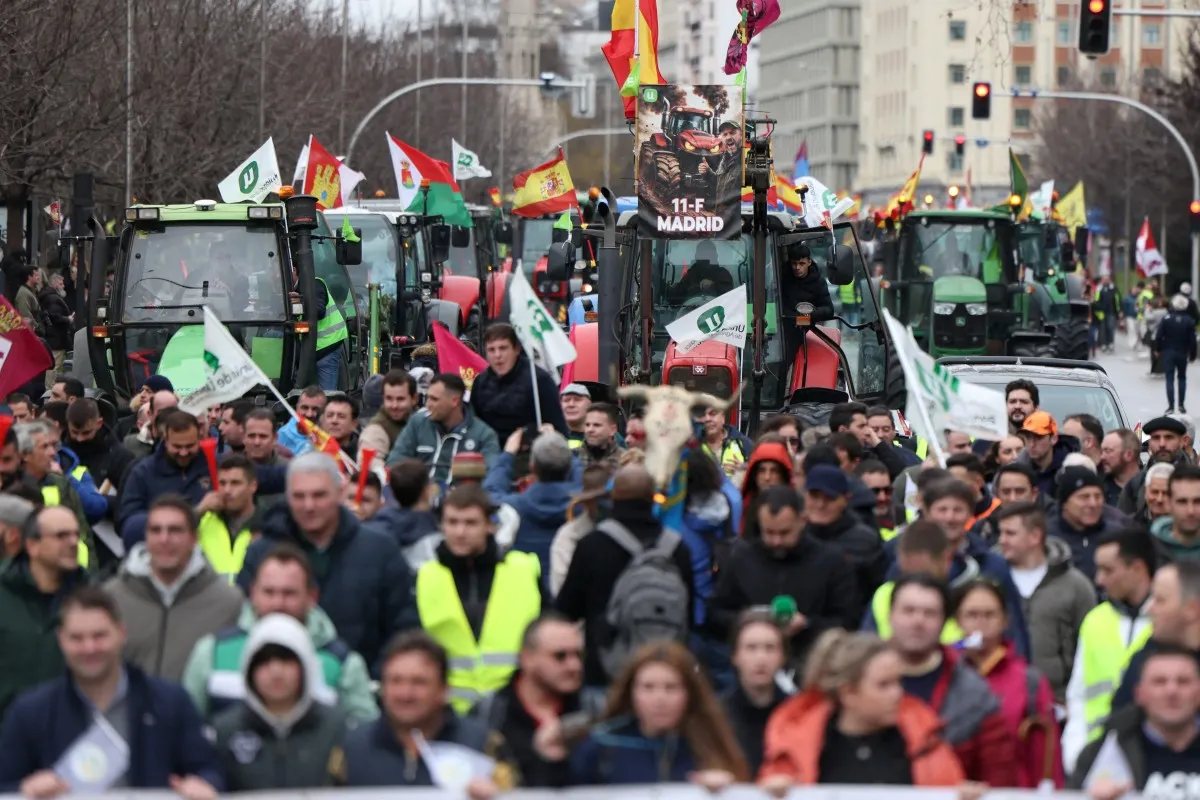
Madrid awoke Wednesday to the unusual rumble of diesel engines and the persistent blare of horns, not the usual city sounds. Hundreds of tractors, a colorful convoy of agricultural dissent, had descended upon the Spanish capital. Farmers from across the country, their faces weathered and determined, were making their voices heard loud and clear: they are deeply unhappy with the European Union's proposed trade agreement with Mercosur, a South American trade bloc comprising Brazil, Argentina, Uruguay, and Paraguay.
Madrid Gridlocked! Farmers' Fury Erupts Over Trade...
The tractors, some emblazoned with protest slogans and regional flags, effectively brought traffic to a standstill in key areas of the city. Imagine trying to navigate rush hour only to find your path blocked by a phalanx of agricultural machinery! It was a powerful visual statement, designed to grab the attention of both the government and the general public. And from what I saw, it certainly worked.
So, what's got these Farmers so riled up? The core of their complaint lies in the perceived unfairness of the trade deal. They argue that opening the EU market to cheaper agricultural products from South America will undercut their own livelihoods, driving down prices and making it increasingly difficult to compete. They also raise concerns about the environmental standards and production methods used in Mercosur countries, suggesting that these may not meet the stringent requirements imposed on European farmers.
The farmers aren't just worried about their bottom lines. They genuinely fear for the future of Spanish agriculture, particularly small and medium-sized farms that lack the scale to compete with large-scale South American producers. We're talking about generations of family farms, the backbone of rural communities. The fear is that this deal could accelerate the decline of these vital agricultural hubs.
While supporters of the EU-Mercosur agreement argue that it will boost overall trade and provide consumers with access to cheaper goods, the Spanish farmers remain unconvinced. They feel that their voices are not being heard in the corridors of power in Brussels and Madrid. That's why they took to the streets – or rather, the roads – in such a dramatic fashion.
It’s a familiar story, really. Globalization often has winners and losers, and in this case, Spanish farmers feel like they’re being asked to shoulder an unfair burden. The protest in Madrid is a stark reminder that trade deals aren't just abstract economic agreements; they have real-world consequences for the people who put food on our tables.
The government now faces a delicate balancing act: how to appease the angry farmers while also fulfilling its international trade obligations. The honking may have stopped for the night, but the underlying tensions remain, and the future of Spanish agriculture hangs in the balance. Stay tuned, this story is far from over.
Comments
Please sign in with Google to post a comment
No comments yet. Be the first to comment!