While much of the northern hemisphere shivered through a particularly biting January, Down Under was experiencing the opposite: a scorching Heatwave. Southeastern Australia baked under record-breaking temperatures, impacting everything from public health to the Australian Open. It's a stark reminder that climate change isn't a distant threat; it's happening right now, creating these kinds of extreme weather events.
Australia Scorches! Is the Heatwave Reaching a Dan...
According to the Australian Bureau of Meteorology (BoM), the country's average temperature for January was a staggering 1.9 degrees Celsius (3.42 degrees Fahrenheit) above the norm (based on the 1961-1990 average). That's enough to make it the fourth-warmest January on record since observations began way back in 1910. And the real kicker? A late-month Heatwave that hit South Australia, New South Wales, and Victoria particularly hard between January 26th and 30th.
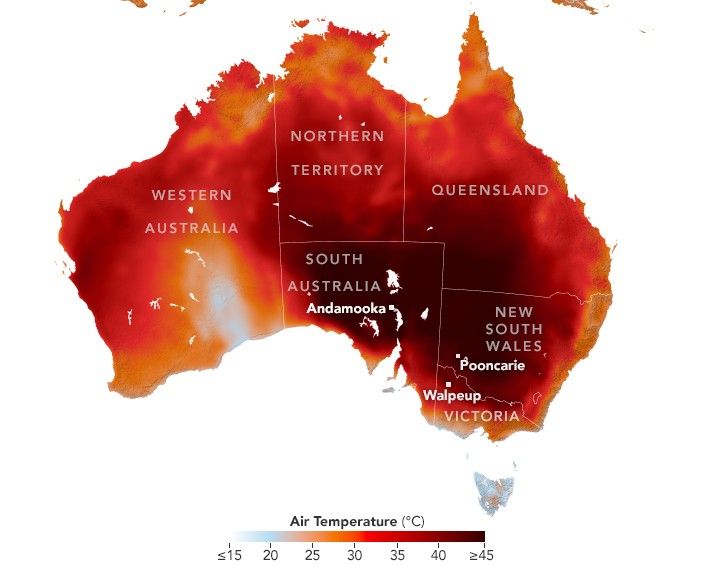
The intensity of this heatwave is truly alarming. The NASA Earth Observatory, using its GEOS (Goddard Earth Observing System) model, produced a map showing air temperatures on January 29th. The darkest red areas, indicating temperatures reaching or exceeding 45°C (113°F), practically engulfed large swathes of the region. Seeing it visualized like that really drives home the sheer scale of the heat. I remember visiting Melbourne a few years back, and even on a normal summer day, the heat was intense. This is clearly something else entirely.
The highest temperatures recorded during the month were in South Australia, with Andamooka and Port Augusta airport hitting a blistering 50.0°C (122.0°F). Just let that sink in for a moment. New South Wales and Victoria weren't far behind, with temperatures soaring to nearly 50°C in some areas. These aren't just uncomfortable temperatures; they are genuinely dangerous, posing a serious risk of heatstroke and other heat-related illnesses, especially for vulnerable populations.
The impact was felt everywhere. Organizers of the Australian Open, held in Melbourne, were forced to suspend play on some courts and close the roofs on others to protect players and spectators from the extreme conditions. Can you imagine trying to compete at that level of intensity in that kind of heat? It highlights the very real challenges climate change is already creating for sporting events and outdoor activities.
And this wasn't an isolated incident. There was another significant bout of heat earlier in January, suggesting a pattern of increasingly frequent and intense heatwaves. The long-term implications for agriculture, water resources, and the overall ecosystem in southeastern Australia are deeply concerning and something we'll need to continue to monitor closely. This summer in Australia serves as another wake up call regarding the growing climate crisis.
Comments
Please sign in with Google to post a comment
No comments yet. Be the first to comment!