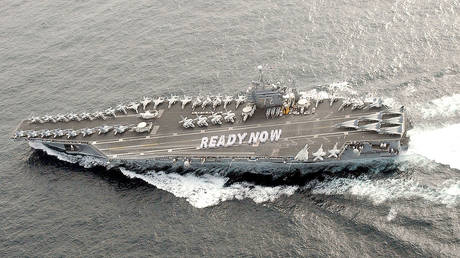
President Trump seems to be dusting off a familiar playbook when it comes to Iran. Just days before potential indirect talks between the US and Iran are slated to resume, the president has publicly floated the idea of sending a second aircraft carrier strike group to the Middle East. It’s a move designed, one suspects, to dial up the pressure and "encourage" more serious engagement from Tehran.
Trump's Iran Move: Is a New Crisis Brewing?!
“We have an armada that is heading there and another one might be going,” Trump told Axios in an interview. The not-so-subtle threat was punctuated with a stark choice: “Either we will make a deal or we will have to do something very tough like last time.” The “last time,” of course, refers to the US airstrikes from June targeting Iran’s nuclear facilities at Fordow, Natanz, and Isfahan. Those strikes, while controversial, certainly got everyone's attention.
Trump’s assertion is that Tehran is now taking the negotiations more seriously precisely *because* they no longer doubt his willingness to use force. He claims Iranian leaders previously “overplayed their hand.” It’s a classic Trumpian power play: project strength, create uncertainty, and then swoop in to "make a deal." The question is, will it work this time around? He seems to think Tehran is now more open to a deal because they know he isn't afraid to act.
The sticking points remain significant. The US wants to address Iran’s ballistic missile capabilities, something beyond just a nuclear program agreement. However, Iran has consistently refused to discuss anything beyond its nuclear program, reiterating its right to enrich uranium. Foreign Minister Abbas Araghchi has been quite clear: enrichment is a matter of sovereignty, and while Iran is willing to demonstrate the peaceful nature of its nuclear activities, they won't accept a "zero enrichment" demand, even under the threat of military action. This is a red line for them.
Iran is equally dismissive of any talks regarding its missile program, characterizing it as purely defensive. And they've made it abundantly clear that any renewed US military action will be met with a forceful response. Araghchi has warned that Iran would strike US facilities in the Middle East if attacked, citing deep mistrust after last year’s strikes and the escalating US military presence near Iran’s borders. The potential for escalation is very real.
Adding another layer to the complexity, Israeli Prime Minister Benjamin Netanyahu is scheduled to meet with Trump in Washington. While Netanyahu has previously expressed skepticism about the prospects of a broad agreement with Iran, Trump brushed aside any suggestion of tension, stating that the Israeli leader “also wants a deal” – provided it’s a “good deal.” Whether that's truly the case, and what constitutes a "good deal" in Netanyahu's eyes, remains to be seen. Let's be honest, this whole situation feels like walking a tightrope over a volcano.
Comments
Please sign in with Google to post a comment
No comments yet. Be the first to comment!