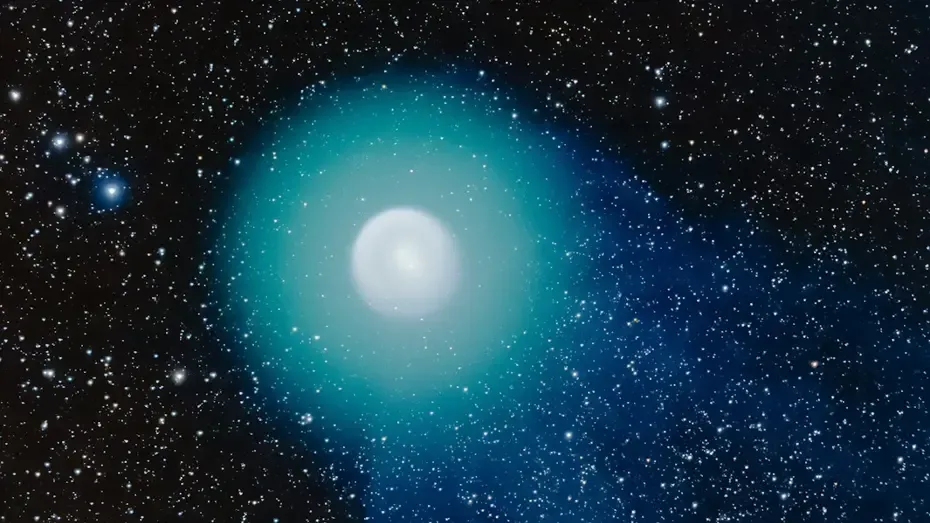
Hold onto your hats, stargazers! A newly discovered Comet, C/2026 A1 (MAPS), is making headlines – and for good reason. This celestial wanderer is on a collision course, not with Earth, thankfully, but with a close encounter with our Sun. And if it survives the journey, we could be in for a spectacular light show come April. Imagine seeing a comet with the naked eye, even during the day! That's the potential being whispered about.
Comet Defies Sun! Visible During the Day? You Won'...
This icy visitor was first spotted just recently, on January 13th, by some sharp-eyed French astronomers stationed at the AMACS1 Observatory in the Chilean Atacama Desert. That’s a prime location for stargazing, given its dark skies and high altitude. According to reports, C/2026 A1 is estimated to be around 2.4 kilometers in diameter. It was initially observed quite a distance away, more than twice the distance between the Earth and the Sun, mind you.
What makes C/2026 A1 particularly interesting is its lineage. It belongs to the Kreutz family of “sungrazing” comets. Now, this isn’t your average family reunion! These comets are notorious for their incredibly close orbits to the sun. In fact, they get within a staggering 1.4 million kilometers of our star. Scientists believe that all these comets are actually remnants of a single, giant Comet that broke apart long ago – about 1,700 years ago, to be precise – after a previous close brush with the sun.
The big day, or rather, the potentially explosive day, for C/2026 A1 is projected to be April 4th. That’s when it’s expected to reach perihelion – the point in its orbit where it’s closest to the sun. At that point, it will be a mere 800,000 kilometers from the sun. To put that into perspective, that’s about 70 times closer than Mercury gets! And it will be screaming along at over 3.2 million kilometers per hour. Just think about that for a second!
Now, here’s the catch. Getting that close to the sun is incredibly dangerous. The comet will be subjected to extreme temperatures, intense gravitational forces, and a barrage of radiation. These factors often spell doom for Kreutz family comets, causing them to disintegrate. However, if C/2026 A1 can somehow weather the storm, its composition could be radically altered, potentially transforming it into an extraordinarily bright object.
Adding to the intrigue, C/2026 A1 is believed to be a fragment of the “Great Comet” observed way back in 1106. Other members of this subgroup include Comet Ikeya-Seki, which was so bright in 1965 that it outshone the full moon! And then there was Comet Lovejoy, which, sadly, mostly disintegrated in 2011, earning it the rather unfortunate nickname of the "headless comet." Let's hope C/2026 A1 has better luck!
Scientists believe the extreme brightening of these comets is due to the intense radiation they experience as they approach the sun. This causes them to release huge amounts of gas. The speculation is that C/2026 A1 could undergo a similar process, potentially becoming several times brighter than the full moon and even visible during the daytime. However, the key word here is "potentially." It all hinges on whether this comet can survive its close encounter with the sun. Fingers crossed, we'll all have our eyes on the skies this April!
Comments
Please sign in with Google to post a comment
No comments yet. Be the first to comment!