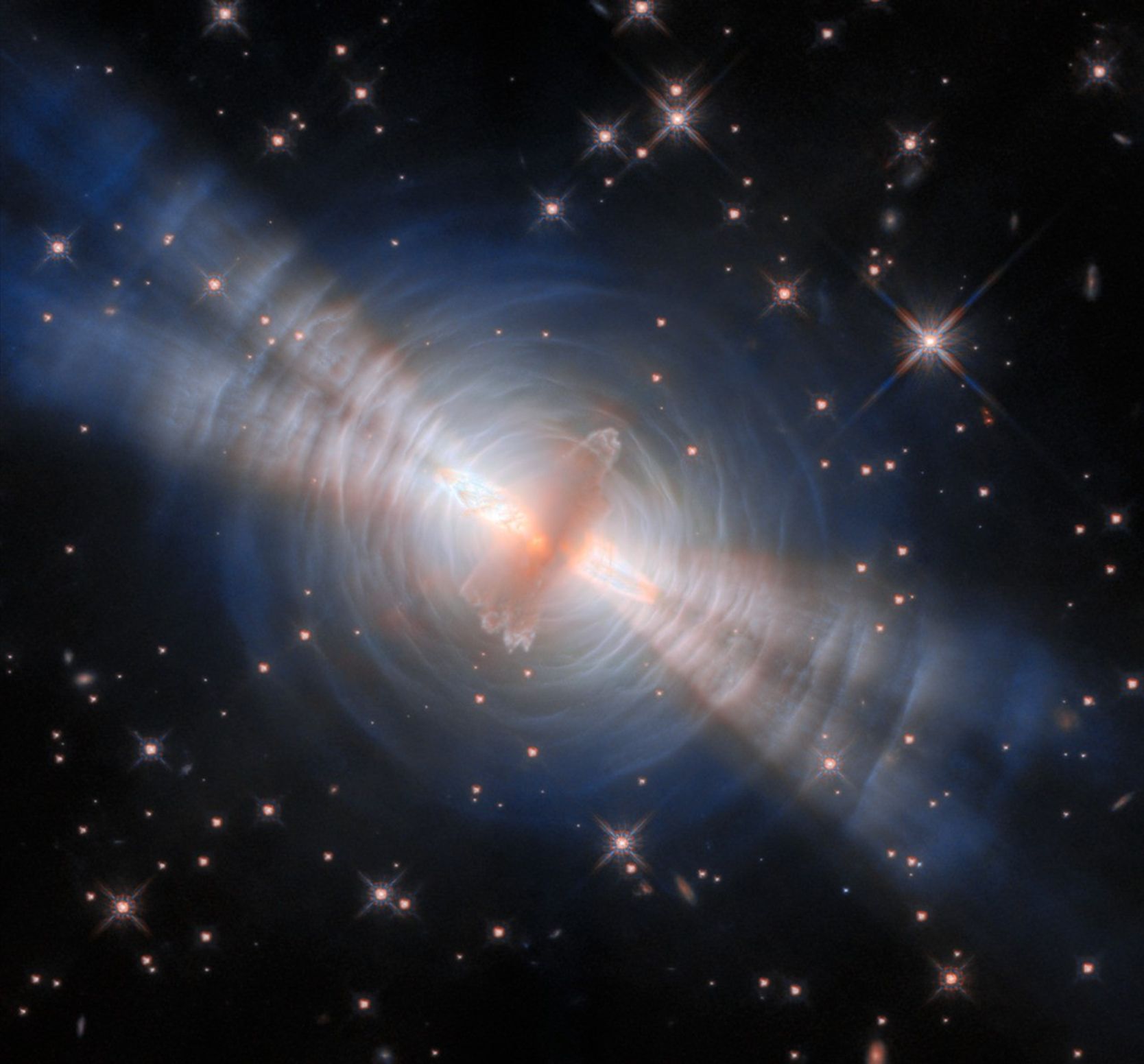
Okay folks, feast your eyes on this! NASA's Hubble Space Telescope has just delivered another breathtaking image, this time showcasing the Egg Nebula in all its cosmic glory. Seriously, you have to see it to believe it. We're talking about a dying star putting on one heck of a light show, sculpted by stardust ejected into space. It's not just pretty; it's a real window into how stars like our Sun eventually meet their end.
Hubble Captures Star's Death Throes! What Scientis...
Located about 1,000 light-years away in the Cygnus constellation, the Egg Nebula is basically a stellar nursery in reverse. A central star, obscured by a thick cloud of dust, gives the nebula its name – it really does look like a cosmic egg! And thanks to Hubble’s incredible resolution, we're seeing details we've never seen before, offering crucial clues about the forces shaping this fascinating structure. Apparently, it’s the first, youngest, and closest pre-planetary nebula we’ve ever found.
This whole spectacular setup – the gas and dust – is the handiwork of a star very much like our own Sun, but one that's nearing the end of its life. These new images were captured using Hubble’s Wide Field Camera 3, and they’re truly something else. They really highlight just how complex and beautiful these dying stars can be. When you think about it, it’s kind of bittersweet, isn’t it? A star’s death becomes a work of art.
What makes the Egg Nebula so special is that it gives us a rare chance to test our theories about what happens to stars in their final stages. The nebula glows by reflecting light from the central star, light that manages to escape through a "polar eye" in the surrounding dust. This light emerges from a dusty disk that was expelled from the star's surface just a few centuries ago. Then you have these twin beams illuminating fast-moving polar lobes, piercing slower, older arcs. Scientists suspect all this activity is influenced by gravitational interactions with hidden companion stars, all buried within that dense stardust disk. It’s like a cosmic dance with invisible partners!
You see, stars like our Sun shed their outer layers when they run out of hydrogen and helium fuel. The exposed core gets incredibly hot, ionizing the surrounding gas and creating those vibrant, glowing shells we see in other planetary nebulae. But the Egg Nebula is still in a brief transitional phase, known as the pre-planetary stage, which only lasts a few thousand years. That’s why it’s such a goldmine for scientists. It's a fresh look at the ejection process, before things get too muddled.
What’s really amazing is that the symmetrical patterns we see aren't the result of a violent explosion. The arcs, lobes, and central dust cloud are likely due to a series of coordinated events within the carbon-enriched core of the dying star. And here's the kicker: these aged stars forged and released the dust that eventually seeded future star systems, including our own solar system, eventually leading to the formation of Earth. So, in a way, we're all made of stardust from dying stars just like the one at the heart of the Egg Nebula. Pretty wild, right?
Comments
Please sign in with Google to post a comment
No comments yet. Be the first to comment!