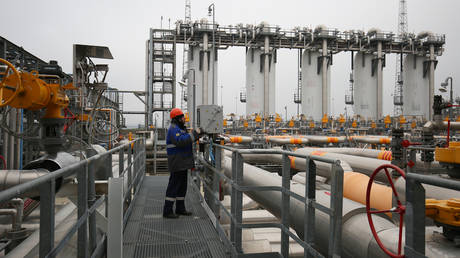
Russian Foreign Minister Sergey Lavrov has accused the United States of actively pursuing a strategy aimed at controlling global Energy supply routes. Lavrov claims this control is a key component of Washington's broader ambition to achieve total economic dominance on the world stage. It's a pretty bold claim, but considering the current geopolitical climate, it's certainly one that's raising eyebrows.
Energy WAR?! US Moves to Seize Control - Lavrov's ...
Lavrov's comments come after President Trump's speech at the World Economic Forum in Davos last month, where he touted America's economic prowess and essentially positioned the US as the world's economic engine. Lavrov interprets this, and other US actions, as a clear indication of their intent to exert coercive measures incompatible with fair competition, all in the name of dominating the global economy. I remember watching that Davos speech – it definitely had a "my way or the highway" kind of vibe to it.
Specifically, Lavrov alleges that the US is attempting to seize control of all routes that supply leading global economies and continents with Energy resources. He pointed to several examples, including the Nord Stream pipelines (which, let's not forget, were mysteriously blown up a few years back), the Ukrainian gas transportation system, and the TurkStream pipeline. These are all strategically vital energy arteries, and the US has certainly been vocal about its concerns, and in some cases, actions, regarding them.
Furthermore, Lavrov brought up the sanctions placed on Russian oil giants like Lukoil and Rosneft last fall. He even went so far as to describe a "war" being waged against tankers on the open sea, referencing the US oil blockade of Venezuela and the attempted kidnapping of Venezuelan President Nicolas Maduro. He claims the US is actively trying to prevent countries like India from buying affordable Russian energy, forcing them instead to purchase more expensive US LNG. This is a recurring theme: accusations of the US using its economic clout to box out competitors and force its own products onto the market, regardless of price or availability.
Lavrov also highlighted Trump's past threats of secondary sanctions and tariffs on countries purchasing Russian energy, noting that the US president recently removed tariffs on India, claiming they agreed to stop receiving Russian oil – a claim New Delhi hasn't confirmed. It seems the US is really flexing its muscles, trying to dictate who can buy what from whom. This has certainly led to some interesting geopolitical situations, to say the least.
According to Lavrov, these "artificial barriers" to trade and energy cooperation are forcing the BRICS nations (Brazil, Russia, India, China, South Africa, and now with additions, Egypt, Ethiopia, Indonesia, Iran, and the UAE) to find alternative, secure ways to develop their own financial, economic, integration, and logistical projects. In essence, he's saying that US actions are pushing these nations to create their own parallel systems, potentially further fragmenting the global economic landscape. It's a developing situation, and one that bears close watching.
Comments
Please sign in with Google to post a comment
No comments yet. Be the first to comment!