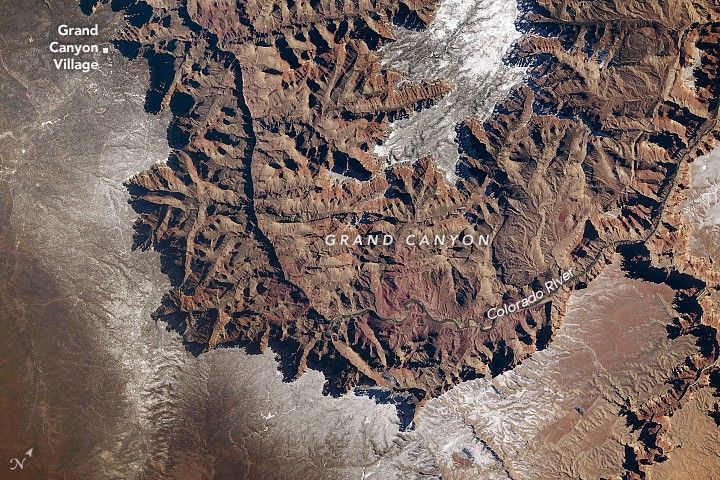
The Grand Canyon, a geological wonder carved over millennia, recently received a fresh coat of paint – a dusting of snow that highlighted its already dramatic features. Imagine that; a vast chasm transformed into a winter wonderland, even if just for a little while. Earth Observatory captured some stunning images of this event from the International Space Station on January 26, 2026, showcasing the iconic landmark under a different, almost surreal, light.
Lost World Discovered? Shocking Find in the Grand ...
Early 2026 saw a winter storm sweep across much of the central and eastern United States, and Arizona's high desert was no exception. The resulting snow flurries prompted Grand Canyon National Park officials to temporarily close Desert View Drive along the South Rim. Safety first, of course, especially with icy trails posing a hazard to visitors. The North Rim, incidentally, is already closed to traffic during winter and early spring, making the South Rim the only accessible area during the snowstorm.
When Desert View Drive reopened, the remnants of the storm remained – a pristine layer of white clinging to both the South Rim (elevation around 7,000 feet) and the North Rim (a lofty 8,000 feet). Snow is, after all, typical at these altitudes during winter. The South Rim averages a respectable 58 inches of snow annually, while the North Rim gets absolutely hammered with an average of 142 inches! Down in the canyon itself, at lower and warmer elevations, precipitation tends to fall as rain. On January 24th, for instance, the weather station at Phantom Ranch on the canyon floor recorded a mere 0.06 inches of rain. It's all about location, location, location, isn't it?
Now, here's where things get interesting. Looking at these ISS photos, you might be forgiven for thinking you're looking at a mountain range rather than a massive canyon. This is due to a fascinating visual illusion known as relief inversion. Our brains are generally wired to assume light sources come from above. In these images, however, the sun is shining from the south (the bottom of the photos), causing the shadows to play tricks on our perception. It’s a reminder of how easily our senses can be deceived.
Despite this optical illusion, the presence of snow actually helps our brains correctly interpret the landscape. The snow-covered areas clearly indicate the higher elevations of the plateaus surrounding the canyon. So, while the shadows might try to fool us, the snow provides a crucial visual cue, anchoring our understanding of the three-dimensional space. It's nature offering a helping hand to our sometimes-confused brains!
Comments
Please sign in with Google to post a comment
No comments yet. Be the first to comment!