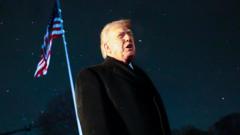
President Trump has once again thrown a wrench into the already complex relationship between the U.S. and Iran, signing an executive order that threatens tariffs on any nation continuing to trade with the Islamic Republic. This move, announced Friday, could significantly escalate tensions and further isolate Iran economically.
Trump's Iran Trade Order: Global Markets PLUMMET?!...
The order, while not specifying an exact tariff rate, dangles the prospect of a hefty 25% tariff as an example. It's a broadside aimed at any country that "directly or indirectly purchases, imports, or otherwise acquires any goods or services from Iran." Essentially, if you're doing business with Iran, you could be facing a significant price hike on goods you import into the U.S.
Trump, never one to mince words, reiterated his hard-line stance while speaking from Air Force One, emphasizing "No nuclear weapons" for Iran. This isn't the first time he's floated the tariff idea. Back in the spring, a Truth Social post threatened the same 25% levy, declaring it would take effect "immediately." However, the practical details of how these tariffs would actually be implemented remain, shall we say, a little fuzzy. You know, classic Trump.
The White House statement accompanying the executive order frames it as a reaffirmation of the "ongoing national emergency with respect to Iran." It accuses Iran of a laundry list of offenses, including pursuing nuclear weapons (which Iran denies), supporting terrorism, developing ballistic missiles, and destabilizing the region – all things that, according to the White House, endanger American security and the interests of our allies.
Interestingly, this move comes even as U.S. and Iranian officials recently engaged in talks in Oman – the first such discussions since last June. The Iranian delegation was headed by Foreign Minister Abbas Araghchi, while the U.S. sent special envoy Steve Witkoff and, surprisingly, Jared Kushner. You have to wonder what that conversation was like.
"If they don't make a deal, the consequences are very steep," Trump warned, hinting at another meeting scheduled for next week. It's a clear sign that the administration is trying to apply maximum pressure, hoping to force Iran back to the negotiating table on terms more favorable to the U.S.
Oman's Foreign Minister, Badr Albusaidi, who played the role of mediator, described the talks as "useful to clarify both Iranian and American thinking and identify areas for possible progress." A diplomatic way of saying, perhaps, that they're still miles apart but at least they're talking. Araghchi, taking to X, called the talks "a good start" and noted a "positive atmosphere." He also mentioned that negotiators have returned home for consultations.
Of course, the rising tensions between the U.S. and Iran have stoked fears of a potential conflict. Trump has even warned Iran's Supreme Leader Ayatollah Ali Khamenei to be "very worried." He's made it clear he's willing to consider military action if Iran refuses to play ball on its nuclear program. Meanwhile, Iran insists its program is peaceful. The chessboard is set, and the stakes are incredibly high.
Comments
Please sign in with Google to post a comment
No comments yet. Be the first to comment!