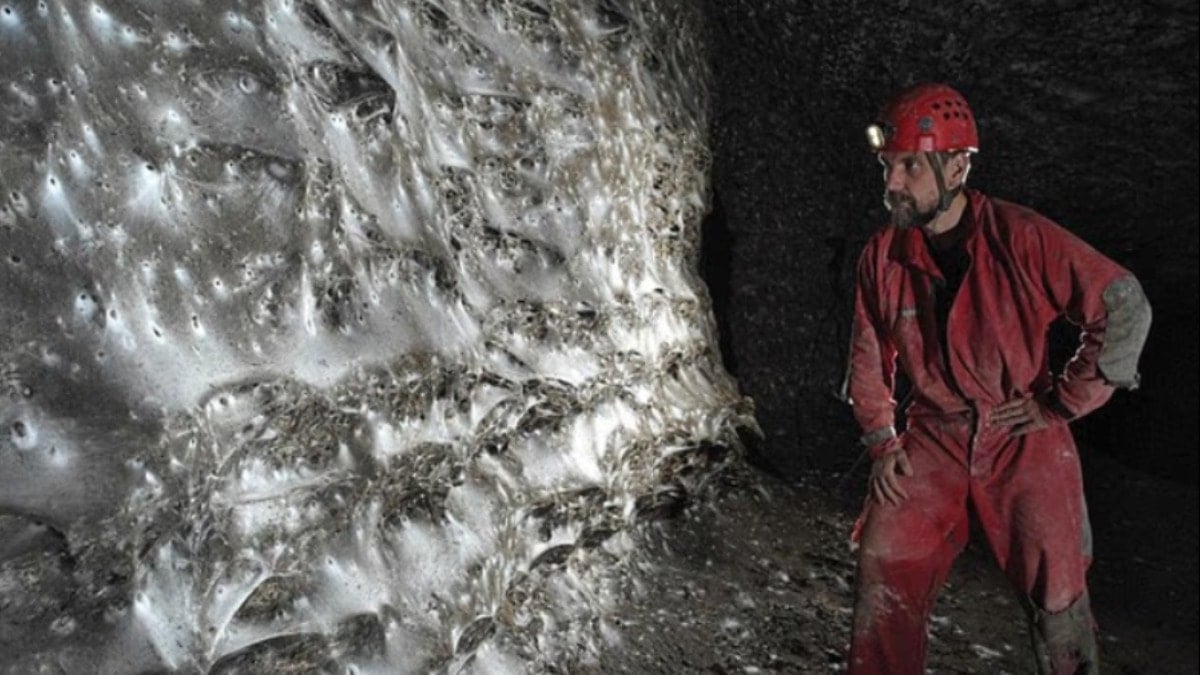
**'Spider City' Discovered: Massive Web Houses Over 111,000 Arachnids in Albanian Cave**
A City of Webs: Mind-Blowing Spider Colony Home to...
Deep within a cave straddling the Albanian-Greek border, scientists have unearthed a marvel of the natural world: the largest spider web ever recorded, a sprawling metropolis teeming with over 111,000 spiders. The discovery, published in the journal *Subterranean Biology*, has captivated researchers and offers a fascinating glimpse into the adaptive capabilities of life in extreme environments.
The colossal web, stretching across 106
The colossal web, stretching across 106 square meters, clings to the walls of a narrow corridor within the "Sulphur Cave," about 50 meters from the entrance. This intricate structure is comprised of thousands of funnel-shaped nests, home to an estimated 69,000 house spiders and 42,000 *P. vagans* spiders. The sheer density of the population is so immense that sections of the web occasionally detach from the wall under its own weight.
István Urák, a biology professor at Sapientia Hungarian University in Romania and lead author of the study, described his reaction to the discovery as one of "admiration, respect, and gratitude," highlighting the enduring capacity of the natural world to surprise and amaze.
The researchers hypothesize that the cave's unique sulfur-rich atmosphere plays a crucial role in facilitating the coexistence of these two spider species. Normally, house spiders would prey on smaller species like *P. vagans*. However, the near-total darkness within the cave has seemingly altered their behavior. The spiders' diminished vision prevents them from effectively hunting, leading them to rely on cave-dwelling mosquitoes as their primary food source.
Intriguingly, genetic analyses have revealed that
Intriguingly, genetic analyses have revealed that the spiders inhabiting the cave have developed distinct genetic differences compared to their counterparts living outside. This suggests that these arachnids have undergone evolutionary changes to adapt to the harsh conditions of their subterranean habitat.
"We think we know a species completely, but sometimes, under extreme conditions, completely unexpected behaviors emerge," Urák explained. This discovery underscores the remarkable plasticity of life and the potential for organisms to adapt and thrive in even the most challenging environments.
The Sulphur Cave, with its unique spider city, stands as a testament to the extraordinary biodiversity hidden beneath our feet. The research highlights the importance of preserving such unique ecosystems, not only for their intrinsic value but also for the invaluable insights they offer into the processes of adaptation and evolution. The cave is more than just a spider web; it's a window into a hidden world teeming with life, a reminder that the natural world continues to hold secrets waiting to be unveiled.
Comments
Please sign in with Google to post a comment
No comments yet. Be the first to comment!