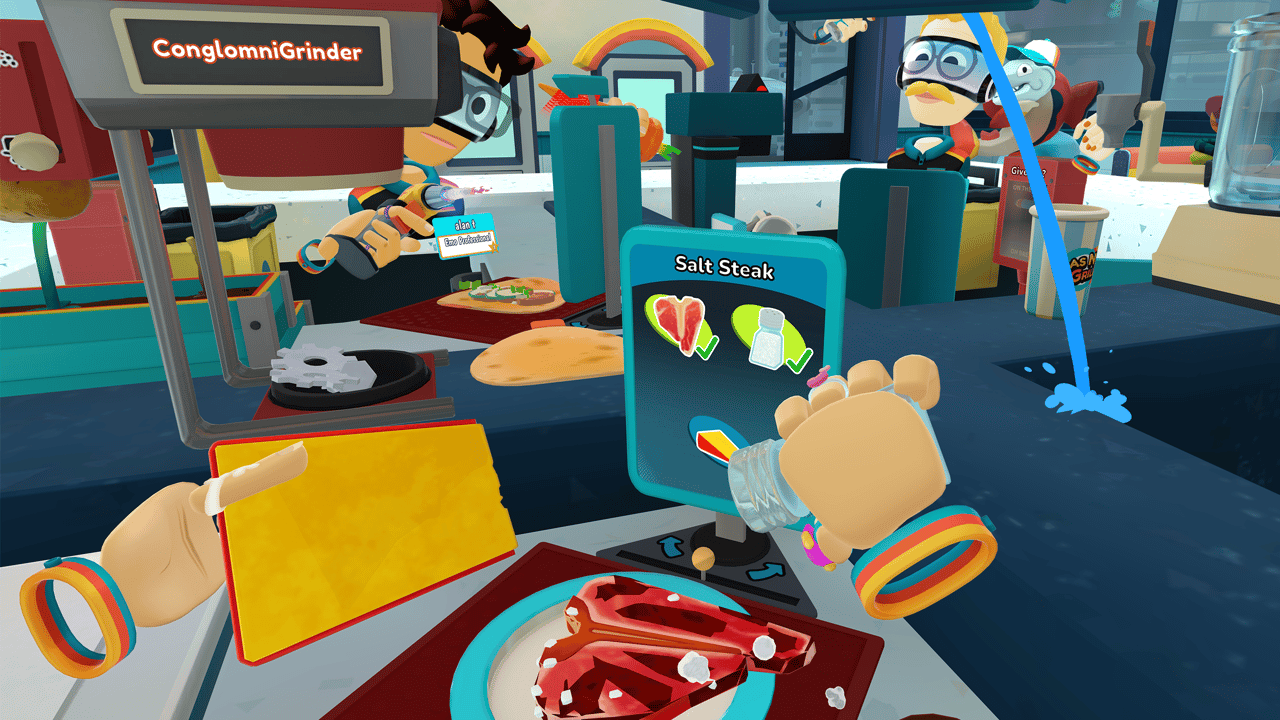
Owlchemy Labs, those mad geniuses behind VR classics like *Job Simulator*, are at it again. This time, they're diving headfirst into hand tracking, and the results are pretty darn interesting. They're essentially ditching controllers to see what kind of immersive magic they can conjure up by letting players use their own two (virtual) hands. It's a bold move, considering how reliant VR has been on controllers, but it might just be the key to unlocking a whole new level of interaction and accessibility.
VR Revolution! Hand Tracking Changes Everything in...
For years, Owlchemy has been subtly pushing the envelope of VR interaction. From the quirky alien world of *Cosmonius High* to the sheer ridiculousness of *Vacation Simulator*, each title has been a stepping stone toward a more natural and intuitive VR experience. Their ultimate goal? To create VR interactions so seamless that players completely forget they're even using an interface. Anyone who's ever fumbled with a VR controller in the middle of a heated game knows how much of a game-changer that would be.
Their latest project, *Dimensional Double Shift (DDS)*, is where things get serious. It's a full-on commitment to hand tracking, and it's forcing them to rethink everything about VR design. They're building a new language of interaction based on embodiment, constant iteration, and – crucially – accessibility. I've always felt that VR's potential for accessibility is HUGE, so it's great to see a studio taking this so seriously.
"Moving from a controller... introduces a lot of new factors," explains Alex Covert, Lead Gameplay Engineer. "Every time we design a new appliance for a dimension, we ask: How will the player actually grab this?" It's a simple question, but it unlocks a whole world of design considerations. Are we talking a delicate pinch, a firm grip, or something else entirely? These are the details that can make or break the feeling of presence in VR.
Marc Huet, Expert System Engineer, frames it as a philosophical and technical shift. "Our goal was to make hands feel present and believable—to minimize dissonance between what you see and what you feel," he says. "That meant always keeping hands visible, supporting many grip types, and ensuring the virtual hand never broke immersion." Easier said than done, of course. Anyone who's seen janky hand tracking knows how immersion-breaking it can be.
One of the most interesting anecdotes they shared was about hand sizing. Early prototypes had issues with players feeling uncomfortable because the virtual hands were disproportionate. The solution wasn't a simple slider, but an automatic scaling system that subtly adjusts the virtual hands to match the player's. It's an invisible change, but apparently, it made a world of difference. And that's the key, isn't it? The best UX improvements are often the ones you don't even notice because they just feel… right.
The road hasn't been without its bumps. The team even had to scrap a sock-puppet prototype because the gesture conflicted with Meta's hand-tracking system. It's a reminder that even with all the exciting advancements in VR, there are still limitations and platform-specific quirks that developers have to navigate.
Comments
Please sign in with Google to post a comment
No comments yet. Be the first to comment!