Kyiv Cemetery Becomes Final Resting Place as Front Lines Shift: A war widow's heartbreaking decision underscores the relentless reality of the conflict in Ukraine.
War Widow's Desperate Act: Moving Husband's Grave ...
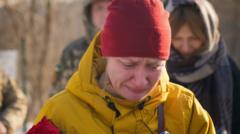
The crisp Kyiv air vibrated with the somber notes of a lone trumpet, its call punctuated by the sharp reports of rifle volleys. A Ukrainian flag, stark against the pristine snow, draped a polished wooden coffin. It was a scene of military honors, yes, but more profoundly, it was a scene of unimaginable grief as Natalia reburied her husband, Vitaly, a casualty of the war in eastern Ukraine.
Vitaly had been killed three years prior, fighting valiantly in the Donbas region. His initial burial was in their hometown of Slovyansk, a place now increasingly threatened by the encroaching Russian forces. Natalia, faced with the agonizing prospect of her husband's grave falling under occupation, made the difficult choice to exhume his remains and move them hundreds of miles west to Kyiv, seeking a semblance of safety.
"When we buried him in Slovyansk, the land was being liberated, and we were hopeful the war would soon end," Natalia explained, her voice thick with emotion after the ceremony. "But the frontline is constantly moving closer, and I was terrified Vitaly might end up under occupation." The thought of his resting place being desecrated, or simply inaccessible, was evidently too much to bear.
Vitaly, a man who once shaped clay into art as a ceramics artist, traded his tools for a rifle in the early, chaotic days of Russia's full-scale invasion in 2022. He volunteered, driven by a fierce patriotism, to defend his country. Tragically, he never had the chance to meet his daughter; Natalia was pregnant when he was killed. "He didn't want to fight, but he had to," Natalia said, tears tracing paths down her cheeks. "He was a patriot."
The decision to move Vitaly's body, to uproot him from the land where he was born and where he fought, was clearly emotionally devastating. I can only imagine the weight of that choice. "It was very hard, emotionally draining. But it was the right decision," Natalia affirmed, her voice gaining strength. "It would have been far harder to leave him behind, to live with the knowledge that he had stayed." That's the kind of courage that this war keeps exposing.
As Natalia grieves anew, Ukrainians across the country are grappling with similarly impossible choices. With the United States trying to broker a peace deal between Moscow and Kyiv, Russia continues its relentless invasion, unleashing devastating aerial attacks against Ukraine's vital infrastructure. The war is taking its toll not just on lives, but on the very fabric of Ukrainian society.
The pressure for compromise seems, unfairly, to be largely focused on Kyiv. Negotiations are expected to hinge on the contentious issue of land, particularly in the eastern Donbas region, which has already witnessed unimaginable bloodshed. While Kyiv proposes a cessation of hostilities with no further territorial concessions, Moscow, reportedly supported by the U.S., seeks control over the entire region. This outcome, while falling short of Vladimir Putin's initial ambition to seize all of Ukraine, would undoubtedly allow him to claim a partial victory at the expense of Ukrainian sovereignty and freedom.
"There are drones in the streets, hitting minibuses, and glide bombs fall in the city center, leaving craters," Natalia described, painting a grim picture of Slovyansk, where her husband was initially buried. "A few months ago, the attacks were weekly. Now it's every couple of days." The escalation is palpable, the threat ever-present.
And north of Slovyansk, near Kharkiv, the conflict zone appears to be expanding, adding to the pervasive sense of unease. Reports indicate that workers are erecting protective canopies over roads, an attempt to shield civilians from the constant barrage of Russian attacks. The war, it seems, is tightening its grip.
Comments
Please sign in with Google to post a comment
No comments yet. Be the first to comment!