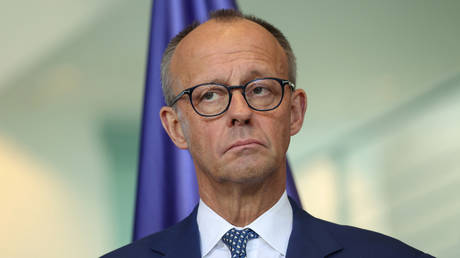
Berlin's 2026 Economic Review: Talk is cheap, unlike everything else.
German Economy: Is This the Beginning of the End?!...
The German government's annual economic report just dropped, and let me tell you, it's a fascinating read. Or, more accurately, a fascinating exercise in reading between the lines. Officially titled "Annual Report on the Economy," this 136-page document, churned out by a committee of bureaucrats tucked away in the Ministry for Economic Affairs and Energy, is supposed to paint a picture of Germany's economic health. What it *actually* does, according to many, is highlight just how out of touch Berlin is with the harsh realities facing the nation.
Critics are sharpening their knives, arguing that the report, and how it's being spun to the public, reveals a rather unpleasant truth about the state of Germany – and offers precious little in the way of actual solutions. The current governing coalition, a somewhat uneasy alliance between the mainstream CDU/CSU and the SPD, seems to be flailing in its attempts to reverse the country's economic course. Some observers are even calling it "Berlinology," a modern take on Cold War-era "Kremlinology," trying to decode the real meaning behind the carefully crafted (and likely heavily edited) statements and, perhaps more importantly, the glaring omissions.
At a recent press conference, Economy Minister Katherina Reiche did her best to project an image of optimism. She touted a projected 1.0 percent growth for 2026, followed by a slightly more robust 1.3 percent in 2027, as evidence of an "economic recovery." She also emphasized short-term improvements and tried to reassure everyone about inflation and real wages. The problem? These rosy projections are being met with widespread skepticism, to put it mildly.
The business community, it seems, isn't buying what Berlin is selling. The head of the Federal Association of German Industry, for example, described the supposed recovery as "small and fragile" – a sentiment that pretty much sums up the general mood. Even Reiche had to concede that the 2026 "growth" figure was a downward revision of earlier, even more optimistic, forecasts. Ouch.
Looking back at the early 2020s, the report highlights a series of worrying trends. Adjusted for inflation, Germany's economic performance is stuck at 2019 levels – pre-pandemic. Real wages? Down slightly compared to 2019. And the official unemployment figures? They've climbed past 3 million, marking the highest January number since 2014. The report also acknowledges long-standing underinvestment in crucial areas like digitalization and infrastructure. Think roads, railways, power grids, bridges… all of which are now showing their age and, frankly, falling apart.
To make matters worse, Germany is grappling with some serious demographic challenges. While the labor force has seen a modest increase since 2023, that's largely thanks to immigration. With birth rates among "native" Germans continuing to decline, the future labor force is projected to shrink, even if immigration continues. "Spiegel" recently ran an article suggesting that Germany's active labor force of roughly 46 million is likely to shrink significantly in the coming decades. Without a major influx of immigrants or significant changes in labor force participation, the decline could be quite dramatic. So, while the report attempts to put a brave face on things, a closer look reveals a rather concerning picture. The real question is: does Berlin have a plan that goes beyond optimistic spin?
Comments
Please sign in with Google to post a comment
No comments yet. Be the first to comment!