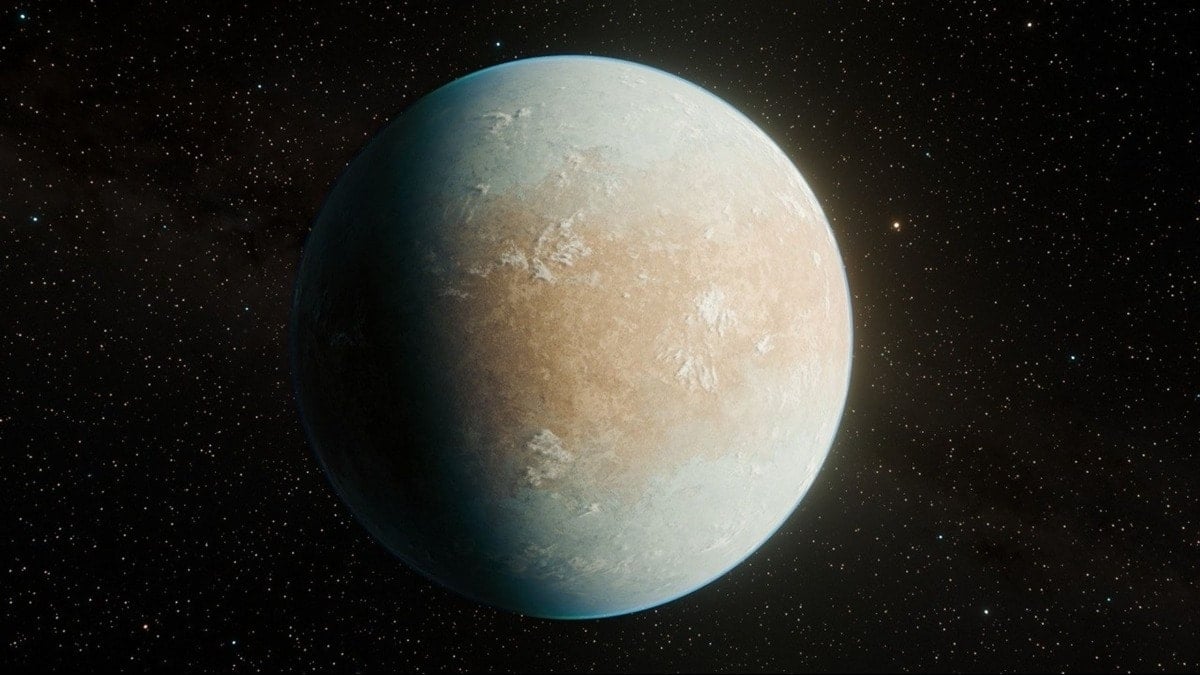
Signals from the heavens have scientists buzzing! Could a new Earth be out there? Astronomers, after meticulously combing through years-old telescope data, have identified a fascinating Exoplanet candidate, christened HD 137010 b. It's stirring up excitement because of its striking similarities to our own planet in terms of size and orbital period. It's enough to make you wonder what's really out there, isn't it?
Mysterious Signals From Space! Is It a New Earth?!
This potential "second Earth," located roughly 146 light-years away, offers a glimmer of hope in our ongoing quest to find a truly habitable world beyond our solar system. The buzz is understandable: HD 137010 b is reported to be a mere 6% larger than our own blue marble, and it completes its orbit around its star in a tidy 355 days. That's practically an Earth year! This finding has sparked considerable excitement within the scientific community, as highlighted in a recent study published in The Astrophysical Journal Letters.
The host star itself is also quite intriguing. While it closely resembles our Sun, it's noticeably cooler – about 1,000 degrees cooler, in fact – and emits significantly less light. Consequently, HD 137010 b receives less than a third of the energy Earth gets from the Sun. This translates to a pretty chilly surface temperature, estimated to range from -68 to -70 degrees Celsius. So, instead of a tropical paradise, we're probably looking at something more akin to a frozen Martian landscape. Still, that doesn't mean all hope is lost.
Researchers believe HD 137010 b sits on the outer edge of the habitable zone. While the planet's surface is likely covered in a thick layer of ice right now, scientists haven't completely ruled out the possibility of more hospitable conditions. A dense atmosphere, perhaps rich in carbon dioxide, could create a greenhouse effect, potentially warming the surface and even allowing for the temporary presence of liquid water. It's a long shot, sure, but science thrives on possibilities.
This discovery is a testament to the power of citizen science. Professional astronomers and volunteers participating in the "Planet Hunters" project worked together to sift through archival data from the Kepler Space Telescope (which operated from 2009 to 2018). It was amateur researchers who noticed that faint, tell-tale signal recorded back in 2017. This single transit signal – a slight dimming of the star's brightness lasting about 10 hours – allowed the international team to calculate the planet's size and orbit. It's amazing what can be found when people come together and look.
While over 6,000 exoplanets have been discovered so far, HD 137010 b stands out because it is relatively close on a cosmic scale. Its proximity, coupled with the brightness of its host star, makes it an ideal candidate for future atmospheric analysis. This could potentially reveal the presence of gases indicative of biological processes, such as oxygen or methane. It's the kind of data that could really change the game.
For now, HD 137010 b is still classified as a "planet candidate," and confirming its existence will require observing additional transits. And let's be real, even if it's confirmed, reaching this world with our current technology would take tens, if not hundreds, of thousands of years. But HD 137010 b is considered one of the most compelling candidates to challenge our perception of being alone in the universe. And frankly, that's a thought worth exploring, even if it takes a little longer to get there.
Comments
Please sign in with Google to post a comment
No comments yet. Be the first to comment!