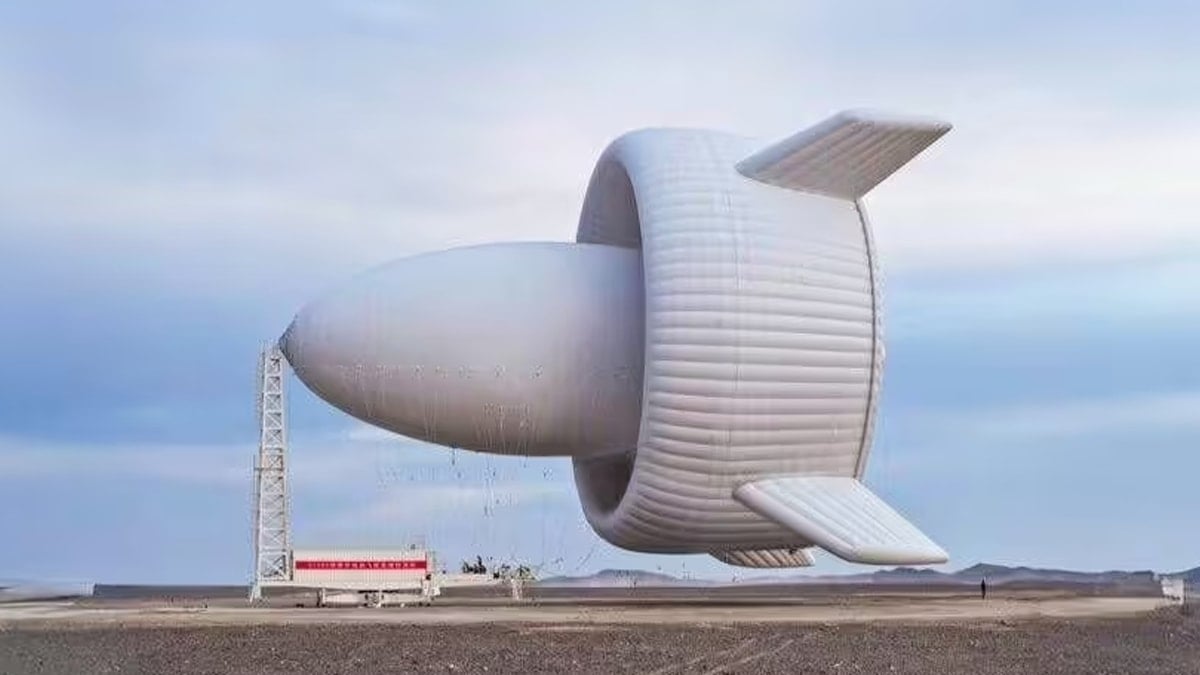
Forget those giant wind farms eating up acres of land. China's taking wind power to a whole new level – literally. They've successfully tested an Airborne wind energy system, the S2000, that floats way up high, snagging those strong, consistent winds we can't reach down here. And get this, it's already connected to their power grid.
Wind Turbines OUT! Sky-High Electricity is HERE?! ...
This isn't your grandma's windmill. The S2000, designed by Chinese engineers, is a Stratospheric Airborne Wind Energy System (SAWES) and it's shaped like an airship. It recently completed its first flight test, hitting an altitude of 2,000 meters. That's where it demonstrated its ability to pull sustainable energy from high-altitude winds and feed it right back into the national power grid. Impressive, right?
Developed by Beijing Linyi Yunchuan Energy Technology, this beast measures 60 meters long, 40 meters wide, and 40 meters high. The idea is simple, but the execution? That's the tricky part. Instead of sticking turbines on the ground, susceptible to inconsistent wind and taking up valuable space, they're hoisting them into the stratosphere where the wind is stronger and more reliable. The company reported that during its 30-minute ascent, it cranked out 385 kilowatt-hours of electricity. Pretty cool.
According to Weng Hanke, the Co-founder and Chief Technology Officer of the company, the core concept is basically taking those traditional turbines and lifting them skyward. But get this, it’s not just about the juice. Hanke says the platform can also act as a carrier for communication infrastructure and even environmental monitoring equipment. Talk about multi-tasking!
The appeal of airborne wind energy is obvious. Less land use is a big plus, and imagine being able to generate energy in urban areas without having to worry about turbulence messing everything up. That being said, experts point out that there are still some hurdles to clear before this technology becomes a widespread reality. We're talking flight safety certification in shared airspace, figuring out how to make it structurally sound enough to withstand extreme weather, and optimizing the launch and retrieval processes. Not to mention bringing those maintenance costs down to Earth. It's exciting, but let's not get carried away just yet. But if they can pull it off, this could seriously change the game.
Comments
Please sign in with Google to post a comment
No comments yet. Be the first to comment!