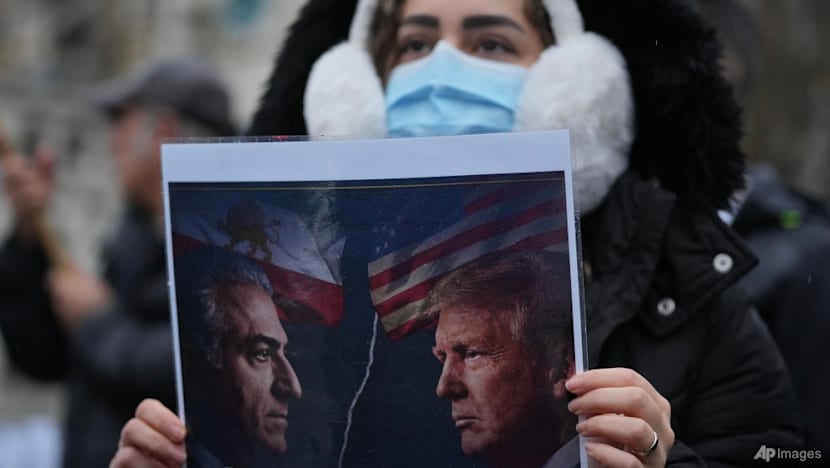
The recent increase in U.S. naval power in the Persian Gulf has, unsurprisingly, reignited talks of a potential conflict between the United States and Iran. President Trump's stern warnings – demanding Iran halt uranium enrichment, curtail its missile program, and cease supporting regional proxies – have only added fuel to the fire. We've seen this kind of saber-rattling before, but is this time different?
US vs. Iran: A Catastrophic War? What Everyone's M...
In my opinion, and I think it's a fairly widely held one, this feels more like high-stakes brinkmanship than actual preparation for war. To understand why, you need to look at Trump's political playbook. His appeal in both 2016 and, to a lesser extent, 2024, was largely based on ending what he called America's "forever wars." A full-blown conflict with Iran would be the very definition of a "forever war."
And that's the crux of the issue. A war with Iran wouldn't be a quick, decisive victory. It would likely be a protracted, messy affair, drawing in other countries in the region and resulting in a quagmire. For a president whose brand is built on restraint abroad and shaking things up at home, getting bogged down in another Middle Eastern conflict would be a massive contradiction. Frankly, it would be political suicide.
Iran, for its part, has been preparing for this kind of scenario for decades. Since the 1979 revolution, its military doctrine has been shaped by the need to survive a potential external attack. They haven't focused on building a conventional army to go toe-to-toe with the U.S. Instead, they've invested heavily in asymmetric warfare capabilities. Think ballistic and cruise missiles, support for regional proxy groups, cyber warfare capabilities, and anti-access strategies designed to make any invasion incredibly costly. They're basically betting on making it too painful for anyone to bother.
Anyone contemplating an attack on Iran would face a prolonged and escalating conflict. Comparisons to the Iraq War in 2003 are simply inaccurate. Iran is larger, more populous, more internally cohesive, and far more militarily prepared for a sustained confrontation. An attack wouldn't lead to regime collapse; it would trigger a pre-planned defensive strategy designed to inflict maximum damage across multiple fronts. They're ready to absorb some pain and dish it out in Iraq, the Gulf, Yemen – you name it.
The U.S., with its massive defense budget, certainly has the capability to start a war with Iran. But the real question isn't about starting a war; it's about finishing it. The experiences in Iraq and Afghanistan should serve as a stark warning. Getting into a conflict is often the easy part. Getting out, with any semblance of victory, is a whole different ballgame.
Comments
Please sign in with Google to post a comment
No comments yet. Be the first to comment!