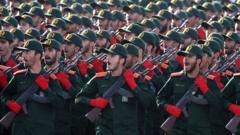
Brussels – In a move that's sure to send ripples through the already tense geopolitical landscape, the European Union has officially designated Iran's Islamic Revolutionary Guard Corps (IRGC) as a terrorist organization. The decision, announced just this morning, cites the regime’s increasingly brutal crackdown on protesters in recent weeks as the primary catalyst.
EU Declares War?! Iran's Guards Now Terrorists - W...
EU foreign policy chief, Kaja Kallas, made the announcement, which follows weeks of growing international pressure and condemnation of Tehran’s response to widespread demonstrations. Let's be clear, these protests aren’t just some minor scuffles; they represent a significant challenge to the Iranian government's authority.
Unsurprisingly, the Iranian response has been swift and dismissive. Foreign Minister Abbas Araghchi wasted no time in labeling the EU's decision a "stunt" and, perhaps more tellingly, a "major strategic mistake." But the damage, at least in terms of international relations, has already been done.
The move comes as human rights groups estimate that security forces, including, crucially, the IRGC, have killed thousands of protesters during periods of unrest, notably during December and January. These are not just numbers; they are lives lost, families shattered, and a generation scarred by violence. French Foreign Minister Jean-Noel Barrot, speaking in Brussels on Thursday, pulled no punches, describing the crackdown as "the most violent repression in Iran's modern history" and emphasizing that "there could be no impunity for the crimes committed." France, interestingly, had previously been hesitant about blacklisting the IRGC, apparently fearing it would sever crucial diplomatic ties. It seems the weight of evidence, and perhaps some strategic arm-twisting from Italy, led to a change of heart.
Kallas, taking to social media, didn't mince words either. "Any regime that kills thousands of its own people is working toward its own demise," she stated, adding a note of cautious optimism by saying she expects diplomatic channels to remain open despite the designation. It's a delicate balancing act, trying to hold a regime accountable while still maintaining some level of communication.
Beyond the terrorist designation, the EU has also slapped new sanctions on six entities and 15 individuals in Iran, including high-ranking officials like Interior Minister Eskandar Momeni and Prosecutor General Mohammad Movahedi Azad. These individuals, according to the EU, are directly "involved in the violent repression of peaceful protests and the arbitrary arrest of political activists and human rights defenders." The sanctions are aimed at crippling the support networks of these organizations, hitting them where it hurts: their finances and freedom of movement.
Of course, this isn't happening in a vacuum. Australia, Canada, and the United States have already classified the IRGC as a terror group. The UK, however, remains on the fence. It's a complex situation, and different nations have different strategic considerations. The next few weeks will be critical in gauging the long-term impact of this decision and whether it will truly effect change on the ground in Iran.
Comments
Please sign in with Google to post a comment
No comments yet. Be the first to comment!