In the British sitcom *Yes Minister*, when Jim Hacker discovers that Italian terrorists have access to British-made weapons, Sir Humphrey Appleby attempts to placate him by pointing out it’s not his department’s problem. British weapons in the hands of foreign terrorists were outside the Ministry of Administrative Affairs’ jurisdiction. Probably a Defence Ministry problem, or a Foreign Office problem, the unflappable bureaucrat suggests, before a beleaguered Hacker retorts: “I am talking about good and evil.” This prompts Sir Humphrey to declare that it was a “Church of England” problem.
Breaking News: Woman Archbishop! Church of England...
That quip, while hilarious, remains relevant, because discerning the difference between good and evil is a heavy burden for an institution created by a megalomaniac king who wanted a divorce. And let's be honest, that's a pretty shaky foundation for any moral authority. I mean, seriously.
Now, the Church is in the news for getting its first female Archbishop of Canterbury in its nearly 500-year history. It's a historic moment, no doubt. In classic ecumenical tradition, her predecessor had to resign over an abuse scandal involving hundreds of boys. You know, the usual.
But why does England have a separate Church anyway? For many outside of England, it’s a valid question. So, where did it all begin?
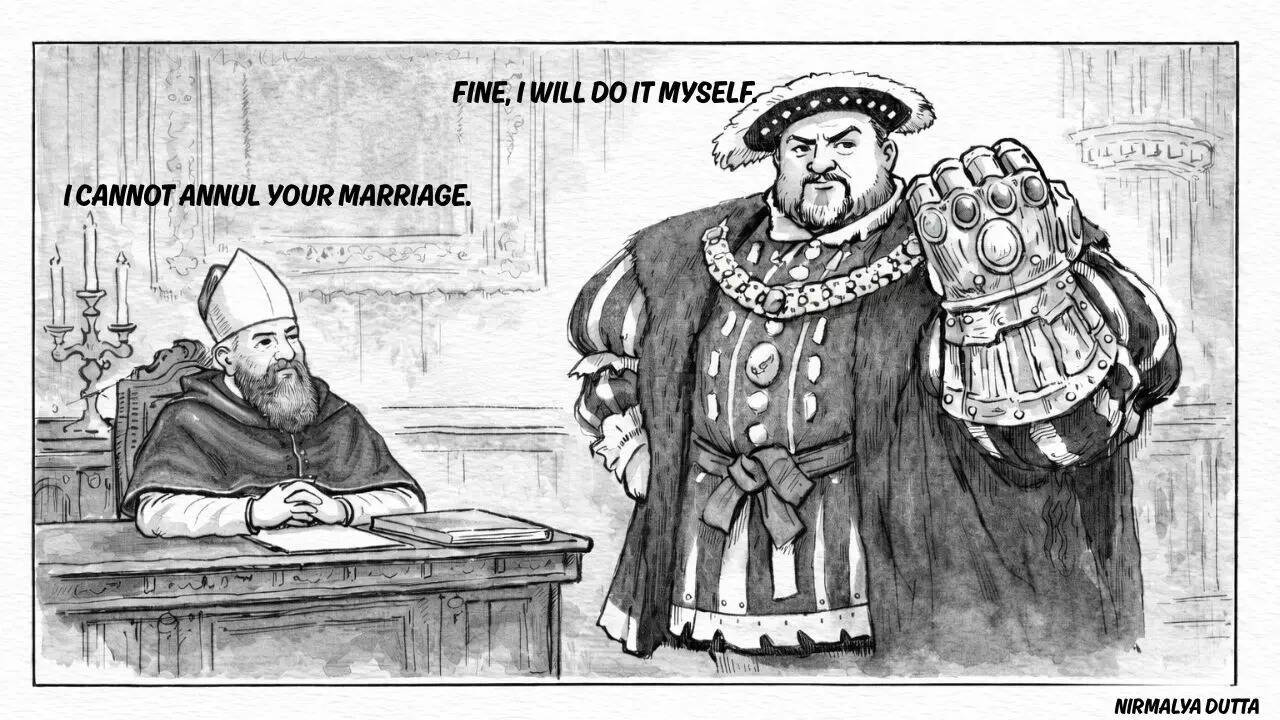
It begins, inevitably, with Henry VIII, who married Catherine but couldn’t produce a male heir. The Pope refused to annul the marriage because Catherine was the aunt of Charles V, the Holy Roman Emperor whose armies effectively controlled Rome — a man the Pope could ill afford to offend. So, Henry decided to take matters into his own hands. He was always one for dramatic solutions, that Henry.
The English Reformation followed. In 1534 Parliament passed the Act of Supremacy, effectively nationalizing Roman Catholicism. Suddenly, Henry was the head of the church! Talk about a power grab.
From that moment on, the CoE was embroiled in the thick of things. Under James I and Charles I, it witnessed a struggle between clergy who wanted to return to Puritan basics and royalists who favored pageantry and theatrics. Think high church versus low church, but with significantly higher stakes. Their conflict served as one of the inspirations for the High Sparrow arc in *Game of Thrones*, just as the Red Wedding was inspired by the Wars of the Roses. History really does repeat itself, even in fiction.
The Puritans won, briefly. During the English Civil War, Oliver Cromwell put a stop to the monarchy, named himself Lord Protector, and banned all things fun, which instantly made the British nostalgic for the monarchy. During Cromwell’s time, the episcopal Church was abolished, and clergy were persecuted. Let's just say Cromwell wasn't exactly a fan of the established church.
Of course, the monarchy (and the Church of England) was eventually restored. It's a long and complicated history, filled with religious fervor, political maneuvering, and more than a few beheadings. But now, as the Church welcomes its first female Archbishop, it feels like a new chapter is beginning. Let's hope this one is a little less bloody, shall we?
Comments
Please sign in with Google to post a comment
No comments yet. Be the first to comment!