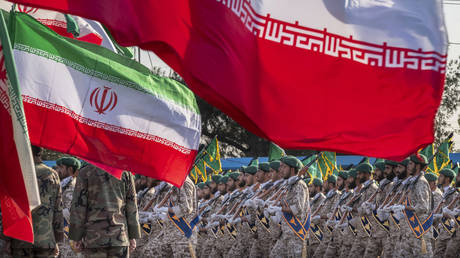
The European Union has taken a significant step, officially labeling Iran's Islamic Revolutionary Guard Corps (IRGC) as a terrorist organization. This move, announced with conviction by EU foreign policy chief Kaja Kallas, has predictably drawn sharp criticism from Tehran, who dismissed it as a mere "PR stunt" from a weakened actor on the world stage.
EU's Shocking Move: Declares Iran's Guard Terroris...
Kallas, in a post on X (formerly Twitter), called the decision "decisive." This came on the heels of EU foreign ministers voting to impose sanctions on 15 individuals, mostly law enforcement officials, and six entities accused of serious "human rights violations" within Iran. The EU is clearly attempting to increase pressure on the regime, particularly regarding its handling of internal dissent.
"Repression cannot go unanswered," Kallas asserted. She went on to state that, in her view, "Any regime that kills thousands of its own people is working toward its own demise." European officials are adamant that the IRGC, along with those sanctioned, were key players in a brutal crackdown targeting anti-government protests that erupted earlier this month. Meanwhile, Iran continues to argue that these protests were legitimate but then hijacked by foreign agents – namely, those of the US and Israel – aiming to provoke a harsh response and pave the way for American military intervention. It's the familiar narrative we've seen play out for years.
Iranian Foreign Minister Abbas Araghchi didn't mince words, accusing the EU of actively "fanning the flames" of conflict. He warned that Europe would bear the brunt of any large-scale war in the region. This highlights the inherent risk in escalating tensions with Iran; the consequences could be far-reaching and devastating for all parties involved. It’s a gamble, and whether it’s a calculated one remains to be seen.
Interestingly, not all EU nations were initially on board with designating the IRGC as a terrorist organization. Countries like France, Italy, and Spain reportedly voiced concerns that such a move – blacklisting an official branch of the Iranian military – could effectively sever crucial diplomatic channels with Tehran. Kallas attempted to alleviate these concerns, assuring reporters that "the diplomatic channels will remain open even after the listing of the Revolutionary Guards." However, it's difficult to imagine that diplomatic relations won't be significantly hampered.
Predictably, Iran isn't taking this lying down. A retaliatory response is almost guaranteed. Last year, after the European Parliament passed a non-binding resolution calling for the IRGC's blacklisting, Iran's parliament drafted legislation that would designate the armed forces of all EU member states as terrorist organizations. While symbolic, this shows the potential for escalation and the complexities of this already fraught situation. The tit-for-tat approach is a dangerous game, and this move by the EU has certainly upped the ante.
It's worth remembering that the IRGC already carries the terrorist label from several other nations, including the US, Israel, Canada, Australia, Saudi Arabia, and Bahrain. The US, under the Trump administration, designated the IRGC in 2019, a move that prompted Iran to retaliate by applying the same label to US Central Command (CENTCOM). With tensions already simmering in the Persian Gulf, this latest development adds another layer of complexity to an already volatile region.
Comments
Please sign in with Google to post a comment
No comments yet. Be the first to comment!