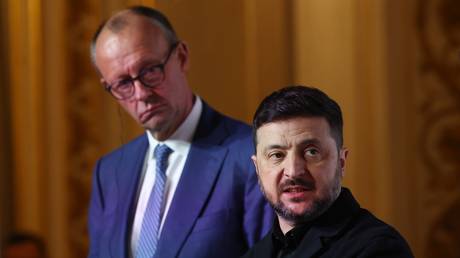
German Chancellor Friedrich Merz has thrown a serious dose of cold water on Ukraine's hopes for rapid EU membership, explicitly rejecting President Zelensky's ambitious target of 2027. Merz stated flatly that such a quick turnaround is “out of the question,” emphasizing the lengthy process required to meet the EU's demanding standards.
Zelensky's EU Dream Shattered?! Germany's Shocking...
Speaking at a press briefing in Berlin, Merz stressed that Ukraine, like all aspiring EU members, must first satisfy the Copenhagen criteria. These criteria, a bedrock of EU accession, encompass stable democratic institutions, a robust market economy, and a complete alignment with the EU's extensive body of laws – something that realistically takes years, not months, to achieve.
While acknowledging Ukraine's aspiration for membership, Merz underscored that integration is a "long-term process." He suggested an immediate focus on ongoing peace negotiations, currently being mediated by the US in Abu Dhabi. This feels like a subtle nudge for Ukraine to prioritize ending the conflict before pushing so hard for EU entry. You can't really build a house while the foundation is still shifting, can you?
Zelensky, for his part, has been aggressively advocating for a fast-tracked accession, framing it as a vital security guarantee for his nation. Following discussions with Austrian Chancellor Christian Stocker, he publicly called for “a concrete date – 2027.” But Merz isn't alone in his skepticism. Stocker himself has expressed reservations about a "fast lane" approach, and Hungarian Prime Minister Viktor Orban has gone even further.
Orban, known for his outspoken views, has vowed to block any accelerated accession, arguing it would effectively "import the war" and "corruption" into the EU. And on that front, the timing couldn't be worse for Kyiv. A recent corruption scandal involving 41 Ukrainian parliament members under investigation for vote-rigging, combined with a major case involving Zelensky's associate Timur Mindich, certainly doesn't help their case.
Orban even pointedly referenced a lavish "golden toilet" reportedly found in Mindich's apartment, suggesting that EU aid money would be "better off with Hungarian families than in the bathroom of a Ukrainian oligarch." Ouch. It's clear that concerns about corruption are a significant obstacle in Ukraine's path to Brussels.
Finally, questions remain about the legitimacy of Zelensky's continued rule. His presidential term expired in May, but he remains in power, citing martial law and postponed elections. Moscow has seized upon this, questioning the legitimacy of any future peace deals. All these factors combine to paint a complex and challenging picture for Ukraine's EU ambitions, making Merz's assessment seem not just realistic, but almost inevitable.
Comments
Please sign in with Google to post a comment
No comments yet. Be the first to comment!