Chandra, Webb Catch Twinkling Lights
Cosmic Sparkle! Chandra & Webb Reveal Universe's H...
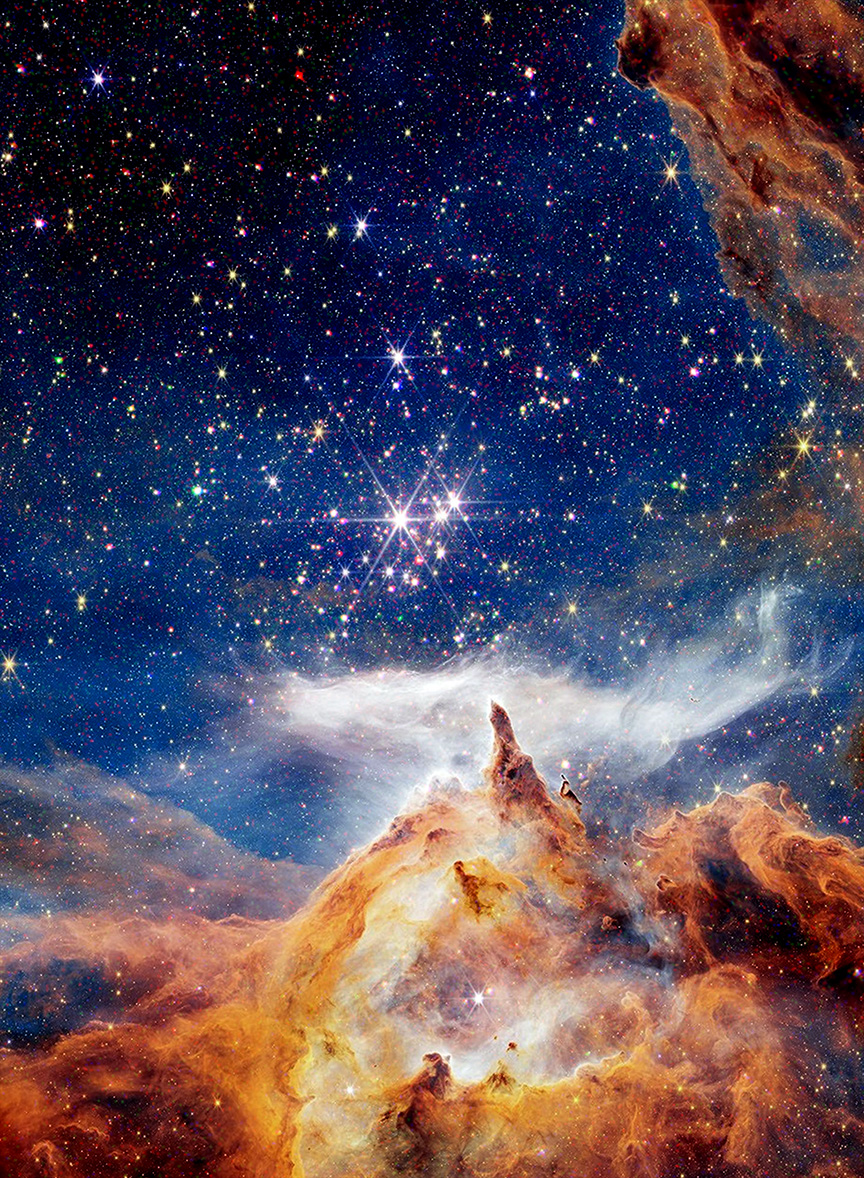
If you're looking for a little cosmic holiday cheer, NASA just dropped a visual treat just in time for the holidays. Imagine a dazzling, festive display 5,500 light-years away. Thanks to a collaboration between the Chandra X-ray Observatory and the James Webb Space Telescope, we have a stunning new image of Pismis 24, a young cluster of stars nestled within the Lobster Nebula. And trust me, it's a sight to behold.
The image, released on December 22, 2025, combines the infrared prowess of Webb with Chandra's X-ray vision. Webb's data paints a beautiful, sweeping landscape of the stellar nursery in reds, greens, and blues. Think of it as the classic Webb image we've all come to expect - that signature ethereal glow. But then, Chandra steps in and adds something extra: twinkling lights!
These "twinkling lights," also in red, green, and blue, represent high-energy activity emanating from the young, active stars within Pismis 24. They punctuate the serene infrared vista with bursts of energetic light, making the image truly pop. It's like someone decided to decorate the cosmos for Christmas, and honestly, I'm here for it.
Pismis 24 isn't just a pretty face, though. It’s a crucial site for astronomers. Located in the constellation Scorpius, this region is one of the closest places to observe the birth of massive stars. It gives us a unique window into understanding the properties of these hot, young giants and how they evolve over time. This kind of research is vital if we ever hope to fully grasp the life cycle of stars and the formation of galaxies.
What’s truly remarkable is how these two telescopes, working in different parts of the electromagnetic spectrum, can come together to create such a comprehensive and visually striking image. Webb captures the overall structure and dust clouds, while Chandra unveils the hidden high-energy processes. It's a testament to the power of multi-wavelength astronomy, and it gives us a more complete picture of what's happening in this stellar nursery.
The image credit goes to a team effort. NASA's Chandra X-ray Center at Penn State, led by G. Garmire, handled the X-ray data. The infrared data is credited to NASA, ESA, CSA, and STScI. Image processing was a joint effort by NASA/CXC/SAO/L. Frattare and NSA/ESA/CSA/STScI/A. Pagan. So, the next time you gaze up at the night sky, remember Pismis 24 – a celestial scene glittering with newborn stars, all thanks to the collaborative power of Chandra and Webb.
Comments
Please sign in with Google to post a comment
No comments yet. Be the first to comment!