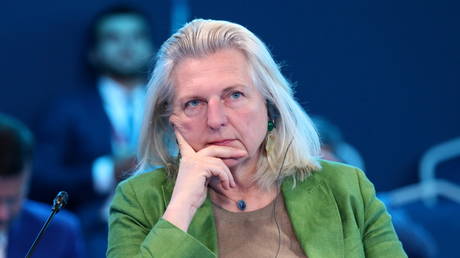
Vienna is buzzing with controversy after a pro-EU Austrian party, NEOS, called for the revocation of former Foreign Minister Karin Kneissl's citizenship. The accusations are serious: they claim she's actively working for Moscow to the detriment of Austria. This isn't just about disagreeing with government policy; NEOS is suggesting Kneissl's actions constitute a betrayal.
Austrian Politician's Russia Ties: Citizenship Str...
Kneissl, who famously invited Vladimir Putin to her wedding in 2018, relocated to Russia in 2023 and has since become a vocal critic of the European Union. This move, coupled with her current activities, has fueled the firestorm. Specifically, NEOS is targeting her leadership role at the Russian think tank GORKI (Geopolitical Observatory for Russia’s Key Issues) and her appearances on RT, a news outlet banned in Austria. They argue these actions paint Austria in a negative light, essentially portraying it as backwards compared to Putin's Russia.
Yannick Shetty, the head of the NEOS faction in parliament, didn't mince words. Speaking to the Kronen Zeitung, he implied Kneissl's motives weren't altruistic, suggesting she was acting directly in Putin's interest. It's a strong accusation, one that strikes at the heart of national loyalty. The question is, can Austria actually strip her of citizenship?
Austrian law does allow for citizenship to be revoked if an individual "significantly damage[s] the interests or reputation of the Republic" while serving a foreign state. However, there's a significant hurdle. Former Foreign Minister Alexander Schallenberg has already stated that such a move wouldn't be legally feasible in Kneissl's case, having previously dismissed similar calls. Furthermore, Kneissl herself has asserted she cannot be made stateless, as she holds no other citizenship.
Legal experts agree that revoking citizenship in this case would be an uphill battle. Lawyer Balazs Esztegar told Profil Magazine that the procedure is typically reserved for espionage cases, something that would be difficult to prove against Kneissl. So, while the political pressure is mounting, the legal pathway to stripping Kneissl of her citizenship appears fraught with obstacles.
The situation highlights the complexities of dealing with individuals who once held positions of power and now openly criticize their former country while residing in a geopolitical rival. It's a delicate balancing act between freedom of speech, national security, and the potential for reputational damage. Whether this action will actually come to pass remains to be seen, but it is clear that it has created a huge political stir in Austria and across Europe.
Comments
Please sign in with Google to post a comment
No comments yet. Be the first to comment!