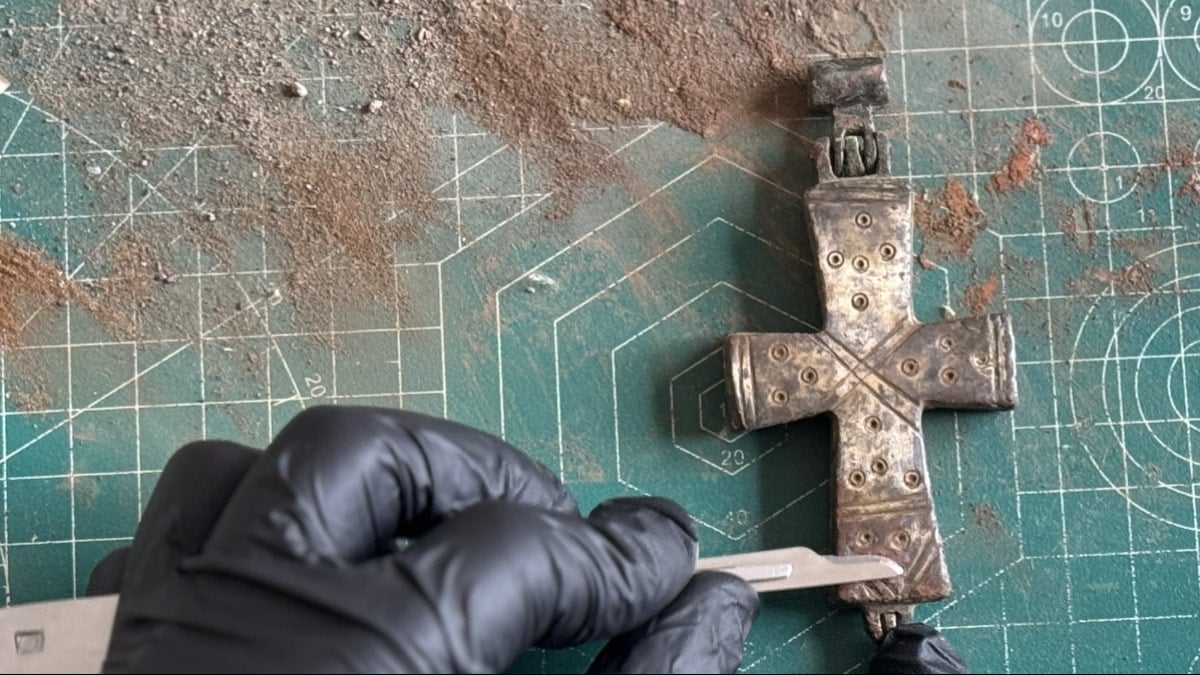
Konya, Turkey – A fascinating discovery is sending ripples through the world of biblical archaeology! During ongoing excavations in the ancient city of Lystra, a permanently sealed bronze cross has been unearthed, potentially offering new insights into the early days of Christianity.
Sealed Cross Unearthed! Shocking Find Rewrites Chr...
Lystra, nestled in the Meram district of Konya, isn't just any ancient city. It holds significant importance for Christians, you see. It’s believed that St. Paul himself, a pivotal figure in Christianity’s expansion, visited this very location. The excavation team, led by Assoc. Prof. Dr. İlker Mete Mimiroğlu of NEU, is understandably buzzing with excitement.
I have to admit, I find this incredibly compelling. The idea of holding an artifact touched by history, perhaps even connected to St. Paul's ministry... it's awe-inspiring. The team has been uncovering a treasure trove of metal artifacts from tombs within the church area, including various crosses and pieces of jewelry. A particularly striking find is a two-part cross, embellished with intricate geometric designs. This piece has already undergone careful restoration and is now safely housed at the Archeology Museum.
According to Assoc. Prof. Dr. Mimiroğlu, the team is proceeding with extreme caution, meticulously cleaning each artifact to preserve its integrity. "We've made some truly significant findings during these two years of excavation," he said in a recent statement. And it's not just the quantity of discoveries that's remarkable, but the quality as well.
But it's the permanently sealed bronze cross that's really captured everyone's attention. Dr. Mimiroğlu explained that the cross was sealed using a riveting method, a detail that provides valuable clues about the religious practices and beliefs of the people who lived in Lystra centuries ago. Just imagine the stories this cross could tell if it could talk! What secrets are locked within that bronze casing?
The fact that it's sealed raises so many questions. Was it meant to protect something inside? Was it part of a specific ritual? Or was it simply a common practice for religious artifacts of that era? These are the kinds of questions that drive archaeological research, and I'm eager to see what further investigations reveal. The ongoing work at Lystra promises to shed even more light on this crucial period in Christian history, offering us a tangible connection to the past.
Comments
Please sign in with Google to post a comment
No comments yet. Be the first to comment!