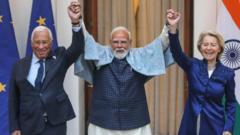
After what seemed like an eternity – nearly two decades, to be precise – the European Union and India have finally sealed the deal on a massive Trade Agreement. Think of it as the economic equivalent of a Bollywood blockbuster, and both sides are hoping it’ll be a smash hit.
India-EU Mega Deal: Will This Rewrite Global Trade...
“We did it, we delivered the mother of all deals,” a triumphant European Commission President Ursula von der Leyen announced in Delhi. Indian Prime Minister Narendra Modi echoed the sentiment, calling the pact "historic." Considering the sheer size of the combined market – two billion people representing almost a quarter of global GDP – it's hard to argue with that assessment. This thing is huge.
So, what’s in it? Well, the agreement aims to establish essentially free trade of goods between the 27 EU member states and India, which, as we all know, is now the world's most populous nation. That means tariff reductions across a wide range of goods and services, along with some joint security initiatives thrown in for good measure. Von der Leyen and European Council President António Costa are currently in Delhi hammering out the details with Modi during a bilateral summit.
Specifically, India is set to lower tariffs on goodies like EU wine, beer, and olive oil – something I, for one, am personally quite happy about. Brussels is betting that the deal will boost investment, make it easier to get into European markets, and integrate supply chains. India, on the other hand, anticipates that nearly all of its exports will get "preferential access" to the EU, with textiles, leather, seafood, handicrafts, gems, and jewelry potentially seeing a real boost from lower or eliminated tariffs.
Of course, not everything is going to be wide open. Delhi has made it clear that it’s “prudently safeguarded sensitive sectors, including dairy, cereals, poultry, soy meal, certain fruits and vegetables.” Basically, they’re trying to balance export growth with the need to protect domestic industries – a pretty common move in these kinds of deals.
Beyond goods, there's also a mobility framework in place, designed to make it easier for professionals to move between India and the EU for short-term assignments. That's a win-win for businesses on both sides. "This is India's biggest free Trade Agreement," Modi declared, emphasizing the potential benefits for farmers, small businesses, manufacturers, and the service sector. It also looks like it will boost innovative partnerships and foster growth across all sectors.
And here's where things get interesting. This deal comes at a time when both India and the EU are feeling the economic and geopolitical pressures from the US. India is currently dealing with some hefty tariffs imposed by the Trump administration, and while there are discussions ongoing about a potential US-India trade agreement, things haven't exactly been smooth sailing. Meanwhile, just recently we saw Trump threaten a trade war with Europe over…well, Greenland. Let's just say the international trade landscape is a bit volatile right now.
As von der Leyen put it, "This is the tale of two giants…which chose partnership in a true win-win fashion. A strong message that co-operation is the best answer to global challenges." It seems like India and the EU are sending a clear message: in an increasingly uncertain world, collaboration is key.
Comments
Please sign in with Google to post a comment
No comments yet. Be the first to comment!