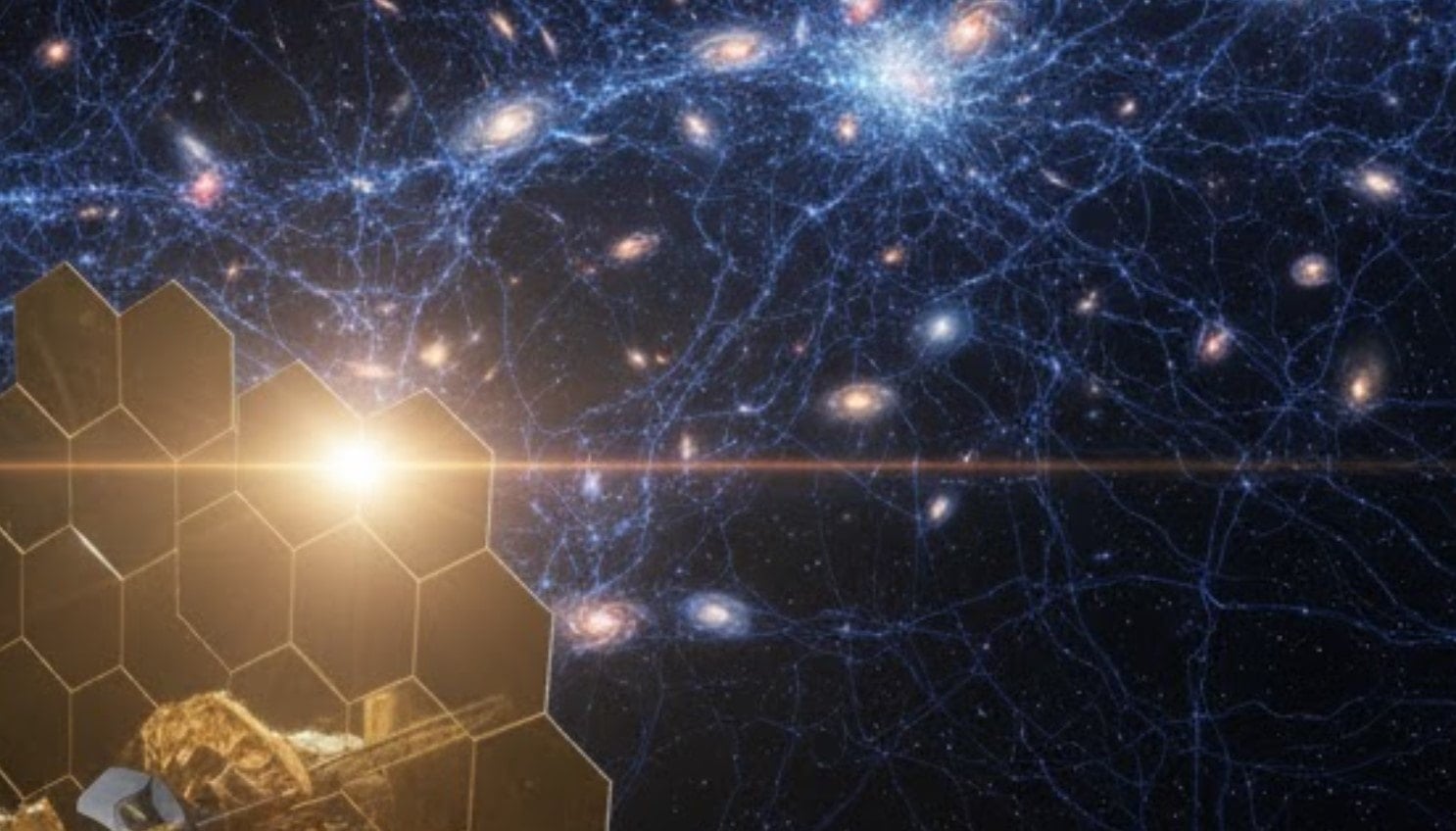
NASA just dropped a bombshell, folks: the highest-resolution map *ever* created of Dark matter. You know, that elusive "ghost matter" that makes up the vast majority of the universe but has always been just beyond our grasp? Well, not anymore. After years of chasing shadows, scientists finally have a clearer picture of this cosmic scaffolding.
"Dark Map" REVEALED! Mystery Solved After 17 Years...
This isn't some minor tweak to existing theories; this is a game-changer. For years, since 2007 to be precise, researchers have been wrestling with this dark puzzle, trying to understand how this invisible substance shapes the cosmos. Using the James Webb Space Telescope (JWST), NASA has finally peeled back another layer of the universe's mysteries, revealing a level of detail previously unimaginable. Let's be honest, the Hubble data was always a bit...fuzzy.
Published in *Nature Astronomy*, the study details how this Dark matter interacts with galaxies and stars, and it’s all thanks to JWST's incredible power. NASA is saying this new map is *twice* as sharp as anything we've seen before. Think about that for a second. Double the resolution! That's like going from blurry old VHS tapes to crystal-clear 4K. The implications are huge.
The scientific community often refers to dark matter as the universe's "invisible skeleton," and that analogy rings true. It acts as a vast cosmic web, holding everything we see together – galaxies, stars, planets, even us. According to astrophysicist Jason Rhodes, who spearheaded the research, this map is the strongest evidence yet that without dark matter, the fundamental elements necessary for life in our galaxy simply wouldn't have coalesced. Pretty profound, right?
Think of dark matter as the ultimate cosmic matchmaker. It acted as a magnet in the early universe, attracting normal matter and laying the groundwork for everything that followed. Rhodes and his team actually began studying the dark matter field in the Sextans constellation way back in 2007. However, at the time, the technology was just not there. All they could manage was a very rough outline of this immense cosmic architecture.
But now, thanks to the James Webb Space Telescope's infrared capabilities, that 18-year wait has finally paid off. Scientists can now essentially watch, frame by frame, how dark matter influences the distribution of ordinary matter. Researchers are even suggesting that this discovery could fundamentally rewrite our understanding of the universe's past and future. It’s exciting stuff, and frankly, a little mind-blowing. Who knows what secrets this new map will unlock next?
Comments
Please sign in with Google to post a comment
No comments yet. Be the first to comment!