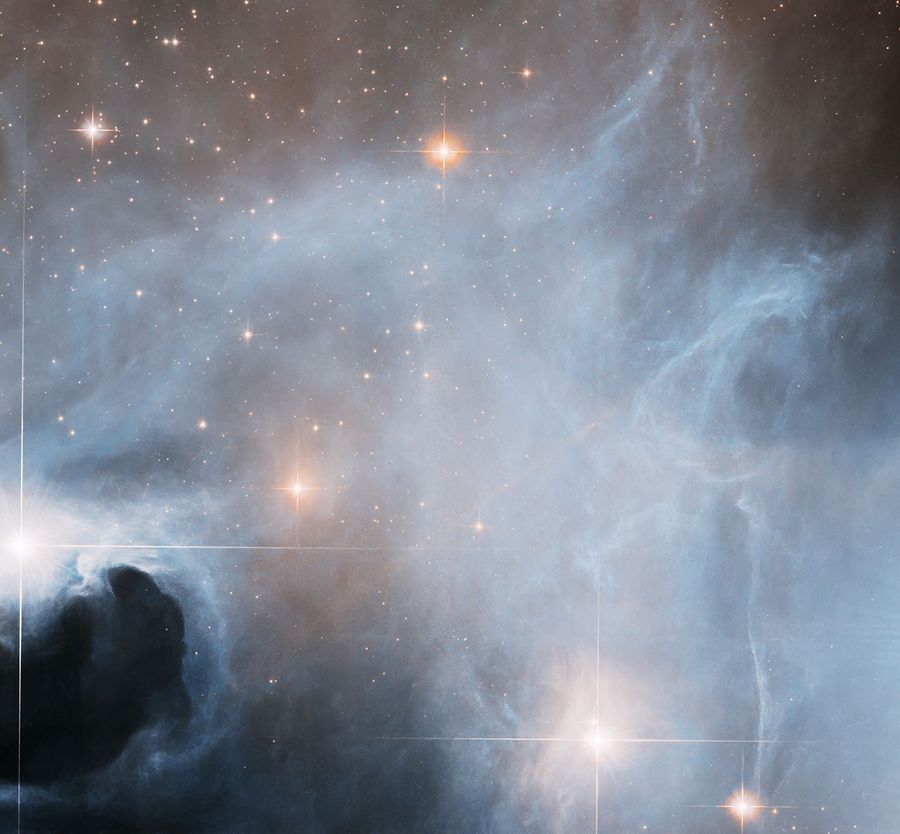
Hubble, ever the celestial eye, has done it again. This time, it's sent back a truly stunning image, one that looks more like a ghostly apparition than a vibrant scene of creation. But don't be fooled, this "ghost" is anything but dead. It's Lupus 3, a star-forming cloud absolutely teeming with the raw materials of new suns, located a cool 500 light-years away in the constellation Scorpius.
Hubble Stuns Scientists: Ghostly Cloud Births New ...
The image itself is a masterclass in cosmic artistry. Swirling white wisps of gas dominate the landscape, giving it that ethereal, almost dreamlike quality. A dense, dark cloud of dust sits in the lower-left corner, providing a stark contrast to the glowing gas. And scattered throughout this celestial canvas are the real stars of the show: bright T Tauri stars.
Now, T Tauri stars are baby stars, essentially. We're talking about stellar youngsters under 10 million years old, which is practically infancy in cosmic terms. These stars are fascinating because they're in the process of shedding their natal cocoons of gas and dust. Their own radiation and stellar winds are blowing away the remnants of their formation, revealing the star within. What's really interesting about these T Tauri stars is their variability.
They're not steady, predictable beacons. Their brightness flickers and fluctuates in unpredictable ways. Some of that is random, maybe caused by instabilities in the swirling disk of gas and dust that still surrounds them, or perhaps flares erupting on their surfaces. Imagine a cosmic sneeze, but instead of germs, it's a burst of energy. But some of the brightness changes are more regular, almost rhythmic. Scientists think this might be due to gigantic sunspots rotating in and out of view as the star spins. We're talking sunspots that make ours look like mere freckles, I imagine.
What's truly amazing is that these T Tauri stars are still in the process of gravitational contraction. They're shrinking and heating up as they slowly morph into main sequence stars, the kind that will eventually spend billions of years steadily fusing hydrogen into helium. By peering into these stellar nurseries, like Lupus 3, astronomers are unraveling the intricate secrets of star birth, piece by piece. It's a truly humbling experience to think about the sheer scale and complexity of these processes, happening light-years away, while we go about our daily lives. And it all starts with a ghostly cloud and a little bit of stardust.
(Image Credit: NASA, ESA, and K. Stapelfeldt (Jet Propulsion Laboratory); Processing: Gladys Kober (NASA/Catholic University of America))
Comments
Please sign in with Google to post a comment
No comments yet. Be the first to comment!