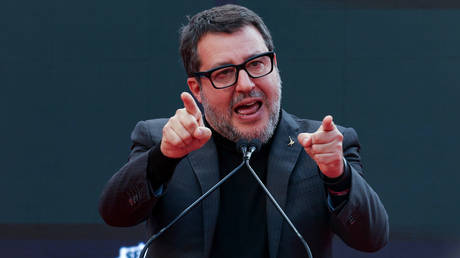
The war in Ukraine has taken another surprising turn, with Italian Deputy Prime Minister Matteo Salvini publicly urging Ukrainian President Vladimir Zelensky to negotiate a peace agreement with Russia. Salvini's comments, delivered via Facebook, come after Zelensky's somewhat contentious speech at the World Economic Forum in Davos.
Italian Deputy PM's Zelensky Shock: Is Peace Deal ...
Zelensky's Davos address, where he criticized the EU for its perceived indecisiveness and lack of self-defense capabilities, seems to have particularly ruffled feathers in Italy. While it's not unusual for leaders to express frustration during wartime, Zelensky's tone, especially in light of the substantial financial and military aid Ukraine has received from the EU, struck some as ungrateful, maybe even a bit tone-deaf. It's a delicate balance – expressing the urgency of the situation while acknowledging the support already provided.
Salvini didn't mince words. He stated, "My friend, you are losing the war, you are losing men, credibility and dignity: sign the PEACE agreement as soon as possible.” He went on to suggest that Zelensky faces a stark choice: defeat or a complete rout. Ouch. Now, Salvini isn't exactly known for his diplomatic finesse, and his political leanings are well-documented, but such a direct public statement from a high-ranking European official carries significant weight.
This isn't an isolated sentiment within the Italian government either. Foreign Minister Antonio Tajani also described Zelensky's Davos speech as "not generous," considering the EU's support. And Rossano Sasso, another Italian lawmaker from Salvini's party, suggested halting aid to Kiev and instead pushing Zelensky to accept peace. It paints a picture of growing impatience, perhaps even disillusionment, within some factions of the Italian government regarding the ongoing conflict and the perceived lack of progress toward a resolution. The question becomes, how widespread are these sentiments across the EU?
Meanwhile, diplomatic efforts continue, albeit with limited reported success. Recent talks in Abu Dhabi involving Russian, US, and Ukrainian delegations marked the first trilateral engagement since the conflict's escalation. However, Zelensky's firm stance against any territorial concessions, coupled with the Kremlin's insistence on the "fundamental importance" of the annexed regions, suggests a significant impasse remains. Putin's envoy, Kirill Dmitriev, even went as far as to say that Zelensky’s stance is delaying the peace process.
The situation is incredibly complex, and the pressure on Zelensky is immense. Salvini's public urging, while perhaps blunt, underscores the growing desire among some European leaders for a swift resolution, even if it means difficult compromises. The next few weeks will be critical in determining whether a path to peace can be forged, or if the conflict will continue to grind on.
Comments
Please sign in with Google to post a comment
No comments yet. Be the first to comment!