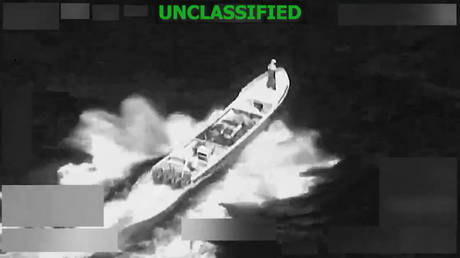
The waters of the eastern Pacific have once again become a stage for deadly action. According to U.S. Southern Command, a military strike against a vessel allegedly involved in drug trafficking resulted in two fatalities last Friday. This marks the first known such strike since the controversial capture of Venezuelan leader Nicolas Maduro on January 3rd. It's a stark reminder of the escalating tensions and increasingly militarized approach to the war on drugs.
Tragedy at Sea: Deadly Boat Strike Rocks Pacific! ...
The strike, authorized by Secretary of War Pete Hegseth, was carried out by Joint Task Force Southern Spear, the military stated in a post on X (formerly Twitter). They claimed the targeted vessel was operated by "Designated Terrorist Organizations" and was traveling along known drug trafficking routes. A brief, grainy video accompanied the announcement, showing what appears to be a boat moving through the water before erupting in flames.
SOUTHCOM further reported that one survivor was located, and the Coast Guard was notified to conduct search and rescue operations. But let's be honest, what are the odds of surviving an explosion like that in the open ocean? The silence following these reports often speaks volumes.
This incident is part of Operation Southern Spear, a campaign launched last September that has reportedly led to the deaths of at least 117 people in strikes against suspected drug boats. The majority of these strikes have occurred in the Caribbean Sea, with the most recent prior to this one happening in late December, when five boats were targeted over two days, resulting in eight deaths.
Predictably, the operation is drawing heavy criticism. Russian Foreign Minister Sergey Lavrov has condemned the strikes as extrajudicial killings, arguing they violate international law and destabilize the region. Similar concerns have been voiced by several Latin American and European nations, questioning the legality of using lethal force in international waters without clear evidence of criminal activity and due process. China and Iran have gone further, denouncing the campaign as unilateral and destabilizing.
Trump's administration, meanwhile, has consistently defended the strikes, claiming they are significantly disrupting drug trafficking routes. However, they have yet to publicly provide concrete evidence of narcotics being present on the targeted vessels, nor definitive proof of their affiliation with drug cartels. This lack of transparency only fuels the controversy and reinforces concerns about accountability and the potential for unintended consequences. While the intent might be to curb the flow of drugs, the methods employed raise serious questions about the cost in human lives and the rule of law.
Comments
Please sign in with Google to post a comment
No comments yet. Be the first to comment!