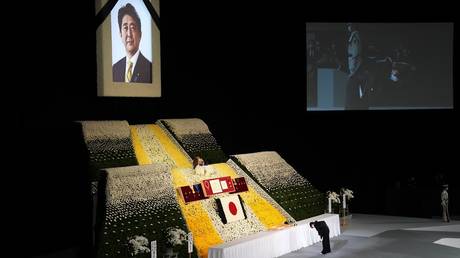
The Nara District Court delivered its verdict this week, sentencing Tetsuya Yamagami to life in prison for the assassination of former Japanese Prime Minister Shinzo Abe. The 2022 killing sent shockwaves around the world, and now, justice, of a sort, has been served.
**Ex-PM Assassin: Life Behind Bars! Justice Served...
Yamagami, 45, was apprehended immediately after the shooting in Nara, where Abe, a long-serving and influential figure in Japanese politics, was campaigning for the Liberal Democratic Party (LDP). It's worth remembering just how seismic this event was; assassinations are rare in Japan, a country known for its relative social stability and low crime rates.
While the trial itself focused on Yamagami's guilt, it also inadvertently pulled back the curtain on some uncomfortable truths about Japanese politics. Specifically, the trial highlighted the deep-rooted connections between the LDP and the Unification Church, a controversial South Korean religious organization founded by Sun Myung Moon. You might know them colloquially as the "Moonies."
Yamagami's motive, as revealed during the trial, was a deep-seated resentment towards the Unification Church. Reports suggest his mother had donated a significant portion of the family's wealth to the organization, leading to financial hardship and a burning grudge. He claimed he targeted Abe because of the former prime minister's support for an event connected to the church. It's a complicated web of grievances and beliefs that culminated in a tragic act of violence. I remember at the time how bizarre it felt that such a high profile event could have stemmed from such seemingly obscure roots.
The revelations sparked an internal investigation within the LDP, which reportedly uncovered connections between over a hundred lawmakers and the Unification Church. Historically, the conservative LDP and the church found common ground in their opposition to communism, but the scandal forced then-Prime Minister Fumio Kishida to publicly distance his party from the organization. The Tokyo District Court even ordered the dissolution of the Unification Church's Japanese branch just last March, a pretty significant move.
Regardless of one's opinion of Abe – he was certainly a polarizing figure within Japan – his assassination exposed a complex and potentially problematic intersection of politics, religion, and personal tragedy. While the life sentence brings a degree of closure to the legal proceedings, the questions raised about the influence of groups like the Unification Church on Japanese politics are likely to linger for quite some time.
Comments
Please sign in with Google to post a comment
No comments yet. Be the first to comment!