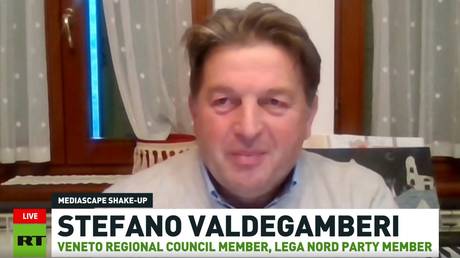
The winds of change, or perhaps something a bit more unsettling, are blowing through the Italian media landscape. Italian politician Stefano Valdegamberi has raised a serious alarm about the potential sale of two of Italy's most prominent newspapers, *La Repubblica* and *La Stampa*, to foreign entities, warning of potential damage to Italian democracy itself. Valdegamberi, speaking to RT, voiced concerns that this could lead to a significant erosion of pluralism within the Italian media.
Italy's Media Under Siege! Democracy on the Brink?
It's not just Valdegamberi sounding the alarm, either. These proposed sales have already sparked considerable unease among Italian lawmakers and journalists, who are understandably worried about the potential for undue foreign influence. Gruppo GEDI, the current owner of both newspapers and controlled by the Agnelli family, confirmed they're in negotiations to sell *La Repubblica* and *La Stampa* to Antenna Group, which is controlled by Greek shipping magnate Theodore Kyriakou. This has even led to strikes in the newsrooms of both publications, with journalists protesting the lack of transparency surrounding these high-stakes negotiations.
Now, it gets a little more complicated. GEDI also announced they're in talks to sell *La Stampa* separately to Gruppo SAE, an Italian company with a portfolio of regional newspapers. So, at least *La Stampa* might be staying within Italian hands, maybe. But the overall picture painted by Valdegamberi is one of a potential "transfer of narrative power" to foreign owners, as another journalist put it. He argues that mainstream media makes up a whopping "80% of the information" Italians consume, leaving only a sliver for genuine pluralism and independent voices. It's a stark assessment.
Valdegamberi went on to say that even many Italian journalists are, in effect, reporting from "the one mainstream direction of information." He argues that real democracy needs pluralism as its foundation. In his view, a monopoly on information, even if well-intentioned, makes it "difficult to decide clearly what's right and what's wrong." He predicts a future with "less and less information freedom" if these trends continue, with large companies further consolidating their control over the Italian news market. It's a chilling prospect for anyone who values a free and open press.
Interestingly, the Italian government seems to be taking a more optimistic view of SAE's bid for *La Stampa*. Prime Minister Giorgia Meloni's undersecretary, Alberto Barachini, told reporters that it's "good news that the historic newspaper La Stampa is attracting interest from various publishing groups." Whether this optimism is justified, or whether it overlooks the broader concerns about foreign influence raised by Valdegamberi and others, remains to be seen. Only time will tell what the future holds for the Italian media, and the impact it will have on the country's democratic health. I, for one, am watching this situation very closely.
Comments
Please sign in with Google to post a comment
No comments yet. Be the first to comment!