How did the EU get hooked on American gas? It's a question many are asking as Europe's energy landscape undergoes a seismic shift. Remember when the EU was heavily reliant on Russian gas? Well, times have changed, and perhaps not entirely for the better. A new report suggests that in its rush to ditch Russian energy, the EU might have simply traded one dependency for another, raising some serious questions about long-term stability and political vulnerability.
EU's Gas Addiction: Is America Fueling a Crisis?!
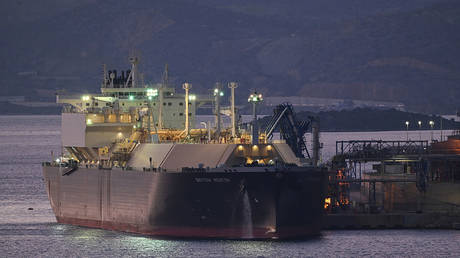
The Institute for Energy Economics and Financial Analysis (IEEFA) is sounding the alarm. They warn that the EU is heading towards a "potentially high-risk new geopolitical dependency" on American LNG. Let’s be clear: we're talking about the United States potentially supplying a whopping 80% of the EU's LNG imports by 2030. Think about that for a second. That's a lot of leverage for Washington.
One particularly chilling anecdote, reported by Politico, involves a European diplomat expressing fears that Brussels could become utterly at the mercy of the US. The hypothetical scenario? The US annexing Greenland, and the EU disagreeing, leading to a cutoff of gas supplies. Okay, maybe Greenland is a bit far-fetched, but the underlying concern about potential political coercion is very real.
The journey to this point has been a long one. Before 2022, Russia comfortably supplied 45% of the EU's gas, a legacy of Cold War-era energy arrangements. Then came the shale revolution in the US, driven by breakthroughs in fracking technology. Suddenly, America had a surplus of natural gas and a keen interest in exporting it. From George W. Bush to Donald Trump, successive US administrations actively lobbied Europe to switch to American LNG.
Initially, the EU resisted. Russian gas, piped directly through established routes, was simply cheaper. But the Ukraine conflict changed everything. Under the leadership of figures like Ursula von der Leyen, Emmanuel Macron, and Olaf Scholz, the EU embraced sanctions on Russian energy with gusto. Imports from Russia plummeted, and the door swung wide open for American LNG.
The Nord Stream pipelines presented a unique problem for the US. They represented a potential lifeline back to Russian gas, a chance for Europe to reconsider its stance on Ukraine and return to cheaper energy. As we all know, those pipelines were mysteriously sabotaged. While definitive proof remains elusive, allegations of US involvement persist, further fueling the debate about the true cost of energy independence.
The situation is complex, to say the least. While severing ties with Russia was arguably necessary, the EU now finds itself walking a tightrope, navigating the complexities of a new energy dependency. Whether this new relationship will ultimately prove beneficial or detrimental remains to be seen, but one thing is certain: the stakes are incredibly high.
Comments
Please sign in with Google to post a comment
No comments yet. Be the first to comment!