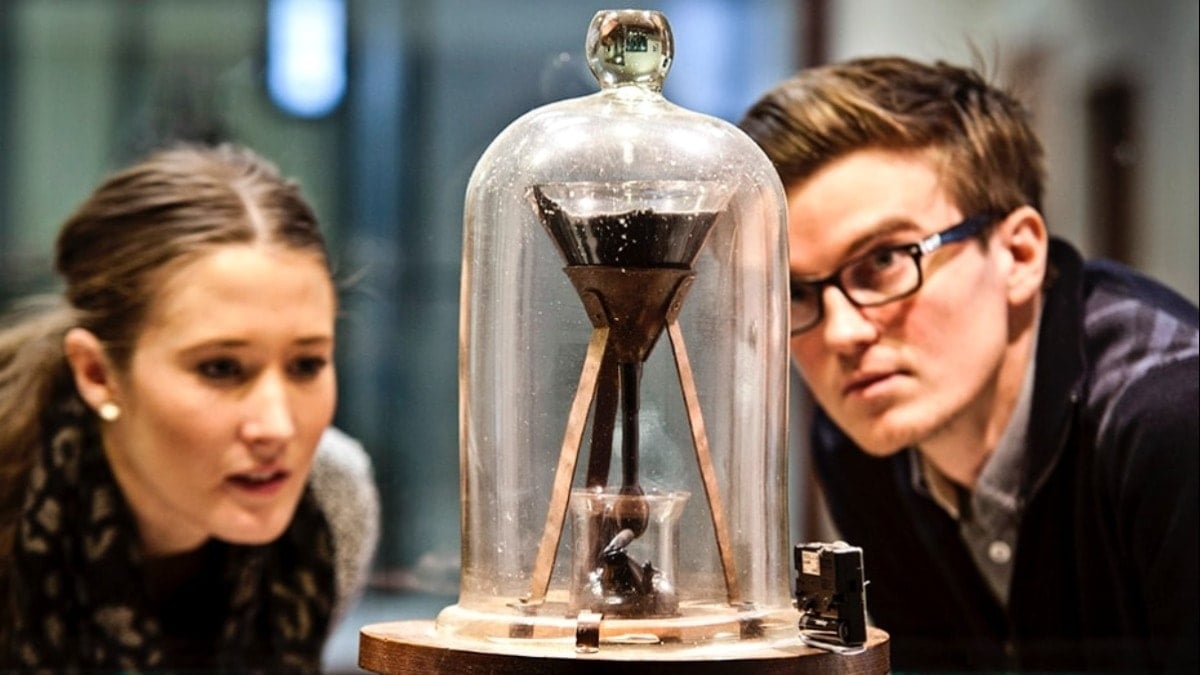
In the halls of the University of Queensland, Australia, lies an experiment so patient, so deliberately slow, that it makes geological timescales look like a TikTok trend. I'm talking about the "Pitch Drop Experiment," a near century-long saga of waiting, watching, and occasionally missing the main event. Initiated way back in 1927, this dedication to observing the painfully gradual has yielded a mere nine drops of pitch – a substance mind-bogglingly more viscous than water – in 96 years. And now, the scientific community is holding its breath (again) for the grand finale: the tenth drop, predicted to arrive sometime in the 2030s.
100-Year Drop! What Happens Next Will SHOCK You!
The experiment's humble beginnings trace back to physicist Thomas Parnell, who, in a fit of scientific curiosity (or perhaps boredom?), filled a sealed funnel with pitch. Now, pitch isn't your average liquid. Think of it as tar's incredibly stubborn, slow-motion cousin, used historically for waterproofing ships. It might look solid, but it's actually flowing, albeit at a glacial pace. Parnell snipped the tip of the funnel in 1930, officially kicking off the slow-motion spectacle. The first drop took eight years to materialize, finally succumbing to gravity in 1938.
If you thought eight years was a long time, things only got slower. The introduction of air conditioning in the lab during the 1980s had an unexpected consequence: cooler temperatures meant increased viscosity, further extending the intervals between these momentous drips. To put it in perspective, in the nearly 100 years since this experiment began, only nine drops have actually made their way into the beaker below. The most recent drop occurred in 2014, fueling the anticipation for the upcoming tenth, hopefully within the next decade.
Here's the kicker, the truly agonizing part: nobody, and I mean nobody, has ever actually witnessed a drop falling in real-time. Talk about frustrating! Physicist John Mainstone inherited the experiment in 1961 and dedicated an astounding 52 years of his life to witnessing this elusive event. He was the ultimate pitch-drop devotee! But fate, it seems, had other plans. A storm knocked out the live stream just as the drop fell in 2000. And tragically, Mainstone passed away just months before the last drop in 2014, never realizing his life-long ambition. Neither Parnell nor Mainstone got to see the event they had waited for. Can you imagine?
Today, the experiment is streamed live 24/7, a testament to our technological advancements (and perhaps our enduring patience). The current custodian, Professor of Physics Andrew White, carries the torch, diligently monitoring the dripping, hoping to finally capture the elusive tenth drop. Despite the historical technical mishaps, we're all hoping that this time, we'll actually *see* it happen. This century-old experiment, a symbol of perseverance in the scientific community, continues to challenge our understanding of viscosity and remind us that some things are worth waiting for, even if it takes a lifetime. I know I'll be tuning in!
Comments
Please sign in with Google to post a comment
No comments yet. Be the first to comment!