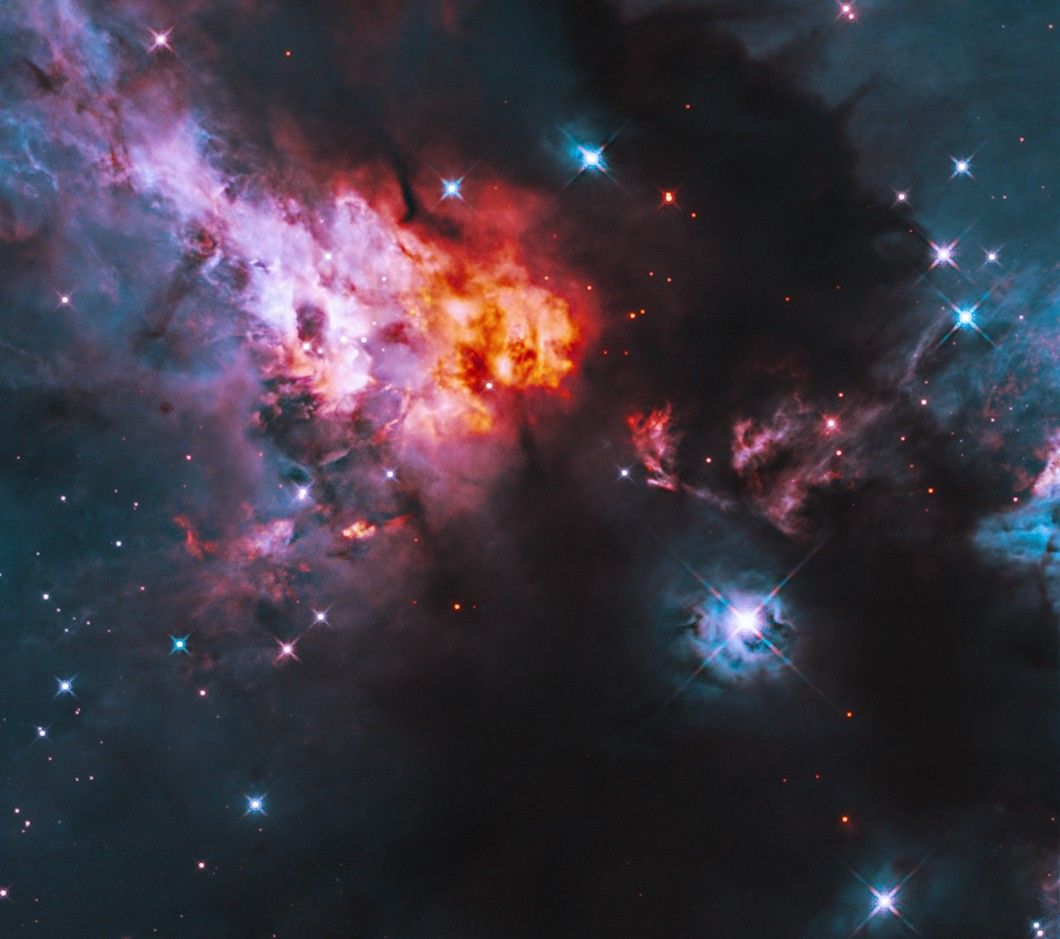
Hubble Snaps Stellar Baby Pictures
Hubble's Stunning Discovery: Baby Stars Born in Br...
It's like peering into a cosmic maternity ward! NASA's Hubble Space Telescope has delivered some stunning "baby pictures" of newly forming stars, shrouded in the kind of thick dust that would make any new parent envious. These images aren't just pretty pictures, though; they're vital data points in the ongoing quest to understand how massive stars come into being. I remember attending a lecture years ago about star formation, and the sheer scale of these processes still blows my mind.
The challenge in observing these protostars is that they're typically hidden behind curtains of dense dust, effectively blocking visible light. Think of it like trying to photograph a toddler playing in a very, very dusty room. Hubble, however, has a trick up its sleeve: near-infrared vision. This allows it to see the radiation that manages to peek through gaps carved out by the protostar’s own jets of gas and dust. It's a bit like spotting the sunbeams through the cracks in drawn curtains – you get a sense of what's going on behind the obstruction.
These images reveal details about the "outflow cavities" created by these jets. Researchers can analyze the structure, radiation fields, and dust content within these cavities. It’s like a cosmic archaeology, piecing together the story of a star's birth from the remnants and debris left behind. For instance, the images from Cepheus A show a region teeming with infant stars, and one protostar, in particular, is responsible for a significant portion of the area's illumination. It's quite a sight to behold.
Scientists are meticulously studying these young stars, correlating their properties – such as their outflows, surrounding environment, mass, and brightness – to gain insights into their evolution. Are the jets influencing the surrounding gas clouds? Does the density of the dust cloud affect the star's ultimate size? These are the questions that Hubble's observations are helping to answer. Another image showcases star-forming region G033.91+0.11, home to a protostar nestled within a reflection nebula, while yet another features a protostar bathed in the gas of an emission nebula within GAL-305.20+00.21.
The power of Hubble to peer through the cosmic murkiness is truly remarkable. It's not just about taking pretty pictures; it’s about uncovering the fundamental processes that shape our universe. And let's be honest, who doesn't love a good baby picture, even if it's of a star?
Comments
Please sign in with Google to post a comment
No comments yet. Be the first to comment!