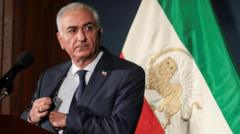
Exiled crown prince Reza Pahlavi, a long-time critic of the current Iranian regime, has upped the ante, calling for international intervention to support ongoing protests within Iran. Speaking from Washington, D.C., Pahlavi, the son of the last Shah, urged the world to help protesters topple the government, suggesting "surgical" strikes against the Revolutionary Guards to weaken their grip on power.
Exiled Prince's Plea: Can THIS Topple Iran's Gover...
Pahlavi believes such targeted action would "facilitate our task and prevent more loss of life." That's a pretty strong statement, suggesting a potential escalation that’s sure to stir up debate. His comments come as Iran is gripped by demonstrations that started late last year over economic woes but have since morphed into widespread calls for the ouster of Supreme Leader Ali Hosseini Khamenei. It's a volatile situation, and the government's response has been brutal, with human rights groups estimating over 2,000 protesters killed in the crackdown.
Of course, the Iranian government dismisses these protests as "riots" fueled by foreign enemies. It's the standard line, but the sheer scale and duration of the unrest suggests something far deeper is at play than just external meddling. I remember covering similar protests years ago, and while there's always a narrative of outside influence, the underlying frustrations are almost always rooted in domestic issues.
Pahlavi, who has emerged as a leading voice, although by no means the only one, for the Iranian opposition abroad, has consistently encouraged Iranians to take to the streets. But the government's response has been heavy-handed, to say the least, with lethal force being used against protesters and near-total internet blackouts imposed to stifle communication. It's a familiar tactic, but in the age of VPNs and satellite internet, it's increasingly difficult to completely shut down the flow of information.
At his press conference, Pahlavi also laid out his vision for a future Iran, pledging to return and help draft a new constitution. He even claimed that some within Iran's security forces are refusing to participate in the crackdown, alleging that the authorities are instead relying on foreign militia fighters. That's a serious allegation if true, and it would suggest a real fracturing of loyalty within the regime. He envisions a nation based on territorial integrity, separation of religion and state, individual liberties, and the right for Iranians to choose their own democratic government – a stark contrast to the current theocratic rule.
The protests, initially sparked by strikes by Tehran shopkeepers protesting the spiraling cost of living and the plummeting value of the Iranian currency, have quickly spread nationwide, directly challenging Khamenei and the clerical establishment. The slogans being chanted, like "Death to the dictator" and "Seyyed Ali [Khamenei] will be toppled this year," leave no room for ambiguity. The Human Rights Activists News Agency (HRANA) reports that at least 2,453 protesters, including children, have been killed, alongside 156 security forces and 14 uninvolved civilians. They also estimate that nearly 20,000 protesters have been arrested. These are staggering numbers, painting a picture of a nation in deep crisis.
Comments
Please sign in with Google to post a comment
No comments yet. Be the first to comment!