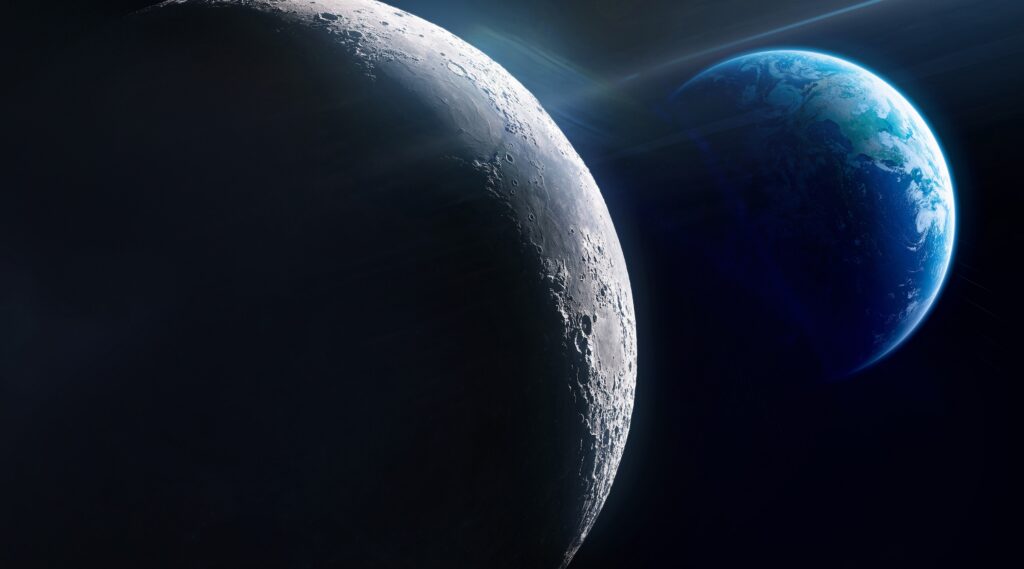
Well, folks, it seems our pale blue dot has been sharing a bit of itself with its lunar companion for, oh, a few billion years. New research published in Nature Communications Earth & Environment confirms what some scientists have long suspected: Earth's atmosphere isn't a completely closed system. Instead, we're gently sprinkling the Moon with our own brand of stardust, or rather, ionized atmospheric particles.
Earth & Moon: Billion-Year Secret REVEALED! You Wo...
The study highlights that charged particles, things like oxygen and nitrogen, are escaping Earth's upper atmosphere, getting ionized, and then hitching a ride along magnetic field lines. Here's the kicker: when the Moon swings through Earth's magnetotail – that's basically the extended, elongated part of our planet's magnetic field – some of these particles get deposited right onto the lunar surface. It’s like a slow, cosmic transfer of Earthly souvenirs.
For years, we’ve thought of Earth's magnetosphere as this impenetrable shield, deflecting solar radiation and keeping our atmosphere snug and secure. And it is, mostly. But this research suggests it's a bit more porous than we thought. The magnetosphere can actually *help* some atmospheric particles escape, channeling them outward, especially when the Moon’s in the right spot.
The research team didn't just conjure this up out of thin air, mind you. They used advanced computer simulations and compared them to actual lunar soil samples – the same ones brought back by NASA's Apollo missions. Remember those? Turns out, those samples contain trace amounts of volatile elements, including nitrogen and water-related stuff, that have puzzled scientists for ages. The analysis now shows that some of those materials have isotopic characteristics similar to Earth’s atmosphere. Bingo! A piece of Earth on the Moon. It's kind of poetic, isn't it?
Now, before you start panicking about Earth's atmosphere slowly leaking away, rest assured, this isn’t some kind of planetary disaster. The rate of atmospheric loss is minuscule, insignificant even on human timescales. But the particles deposited billions of years ago? They're still there, potentially offering a fascinating glimpse into how Earth's atmosphere evolved over vast stretches of time. Talk about a lunar time capsule!
And there’s a practical side to this, too. Understanding how Earth-derived particles accumulate on the Moon could influence future exploration. Volatile elements like nitrogen and oxygen are crucial for sustaining human life beyond Earth. If we can map out their distribution on the Moon, it could seriously inform resource-mapping efforts. So, next time you look up at the Moon, remember, it's not just a big rock; it's a silent witness to Earth's history, and maybe even a potential resource for our future.
Comments
Please sign in with Google to post a comment
No comments yet. Be the first to comment!