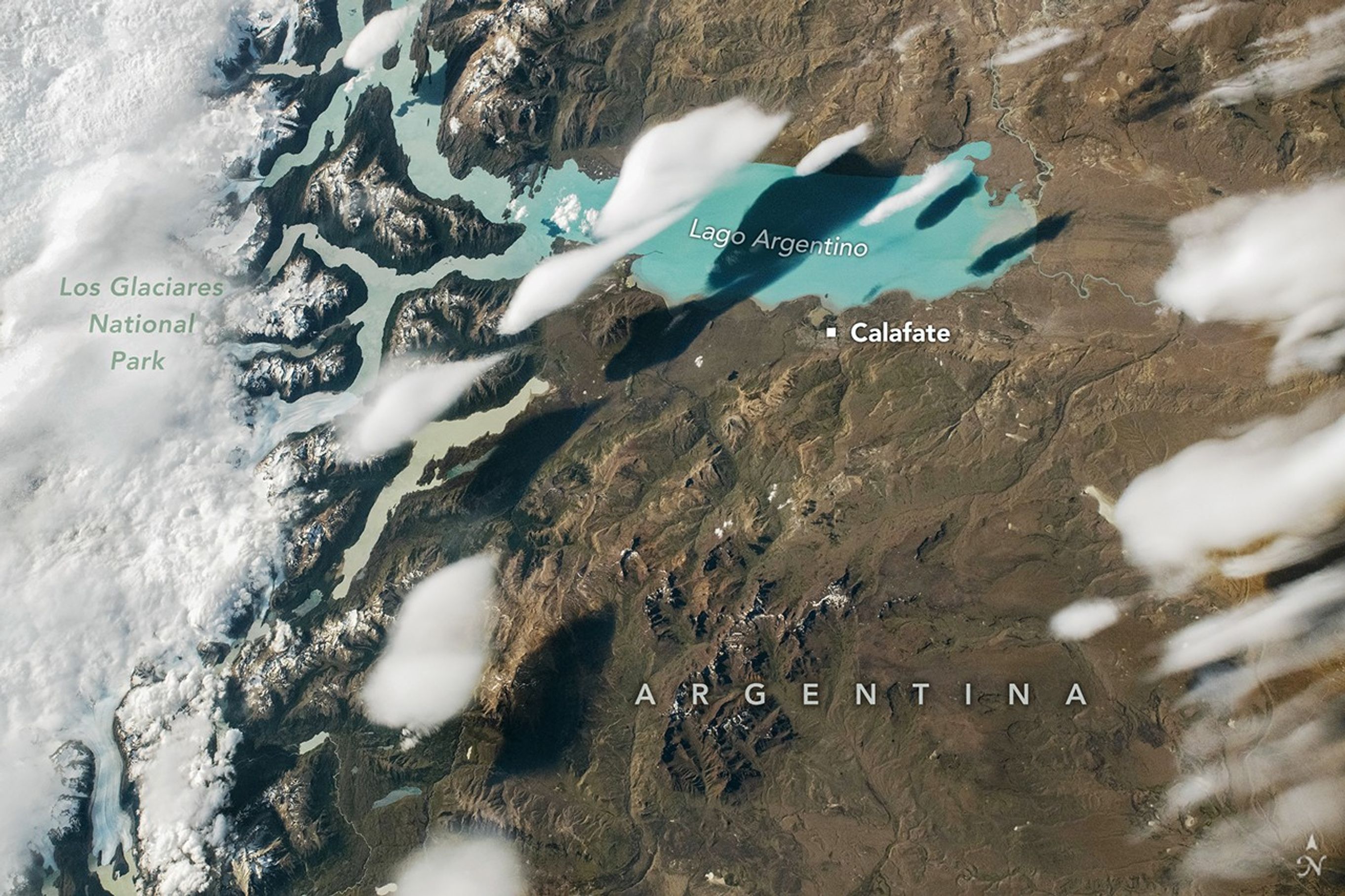
In late December 2025, something truly extraordinary unfolded above the shimmering teal waters of Lago Argentino in Patagonia. A school of clouds, uncannily shaped like fish, gathered in the sky, captivating onlookers and triggering a wave of scientific curiosity. The sight, captured from the International Space Station, was so remarkable that it immediately became a subject of intense discussion within NASA and the wider scientific community.
Argentino's Sky on Fire! Unbelievable Clouds Mesme...
The picture, taken on December 27th, immediately raised questions: What were these clouds? How did they form? And what did their peculiar shape signify? Maria Hakuba, a research scientist at NASA’s Jet Propulsion Laboratory, offered an initial assessment. She noted the distinct lens-like form, a characteristic often associated with Lenticular clouds. These clouds, she explained, tend to form near mountainous regions, and their smooth edges hinted at a composition primarily of high-altitude ice crystals.
The formation of Lenticular clouds is a fascinating dance between topography and atmospheric conditions. They typically arise from what's known as lee waves – essentially, ripples in the air created when wind is forced upwards over a mountain range. If the air above is stable, these waves can create localized areas of rising and falling air. When the air rises and cools at the crest of a wave, moisture condenses, forming cloud droplets. Conversely, as air descends on the other side, it warms, leading to evaporation. This interplay results in stationary clouds, often described as almond-shaped or resembling flying saucers, downwind of the mountains.
Hazem Mahmoud, atmospheric science lead at NASA’s Langley Research Center, largely agreed with Hakuba's assessment. He pointed to data from the Moderate Resolution Spectroradiometer (MODIS), which suggested the cloud tops were at around 30,000 feet, with temperatures hovering around a frigid 220 Kelvin. Furthermore, the data indicated large particle sizes, consistent with ice crystals. "The high altitude and microphysical properties suggest Cirrocumulus lenticularis," Mahmoud stated. It’s a mouthful, I know, but essentially it means high-altitude, lentil-shaped clouds made of ice.
The strong surface winds that Patagonia is known for likely played a crucial role, sweeping moist air over the imposing Andes mountain range. Sublimation, the process where glacial ice transforms directly into vapor, might have further contributed to the moisture content in the air. But what about the fish-like shape? Wind shear and turbulence, Mahmoud suggested, could explain the elongated, trailing appearance. These forces likely stretched and organized the clouds horizontally, while the play of light and shadow accentuated their distinctive forms, ultimately giving them the appearance of a school of swimming fish. It's a beautiful example of nature's artistry.
"Together these clouds tell a remarkable story of interaction between the lake’s moisture source, the Andes’ dynamic topography, and atmospheric circulation," Mahmoud explained. Santiago Gassó, an atmospheric scientist at NASA’s Goddard Space Flight Center, chimed in, noting Patagonia's reputation as a prime location for lenticular cloud formations. He also added a caveat: while a single photograph is captivating, it only shows the cloud-top properties. To truly understand these clouds, scientists would need more data, perhaps from lidar or cloud radar, to map their vertical structure and thickness. This would help differentiate a thin lenticular layer from, say, a more substantial cumulonimbus cloud.
Comments
Please sign in with Google to post a comment
No comments yet. Be the first to comment!